Sie sollen agil arbeiten? Sie wollen es selbst? Vielleicht haben Sie schon ein paar erste agile Gehversuche gemacht? Jetzt haben Sie aber noch ein paar Fragen? Sie sind nicht allein. Ich zum Beispiel bin kürzlich gefragt worden:
Agilität – kann das jeder?
Einzelne Menschen müssen nicht agil werden.
Sie sind es nämlich schon. Jede und jeder von uns. Agil heißt nämlich: Lernen. Oder besser noch: Erfolgreich Anpassen. Und wenn Menschen etwas können – zumindest grundsätzlich – dann das.
Die Antwort lautet deshalb: Ja. Agilität kann jeder.
Und zwar ohne, dass dazu viel getan werden müsste oder gar getan werden kann. Dafür sorgt das evolutionäre „Betriebssystem“, mit welchem wir alle auf die Welt kommen.
Eine der zentralsten Prinzipien der Agilität
ist der PDCA-Zirkel, auch bekannt als „Deming-Kreis„. Der besteht aus den folgenden vier Phasen: 1. Planning, 2. Doing, 3. Checking (Studying), 4. Adjusting bzw. Acting.
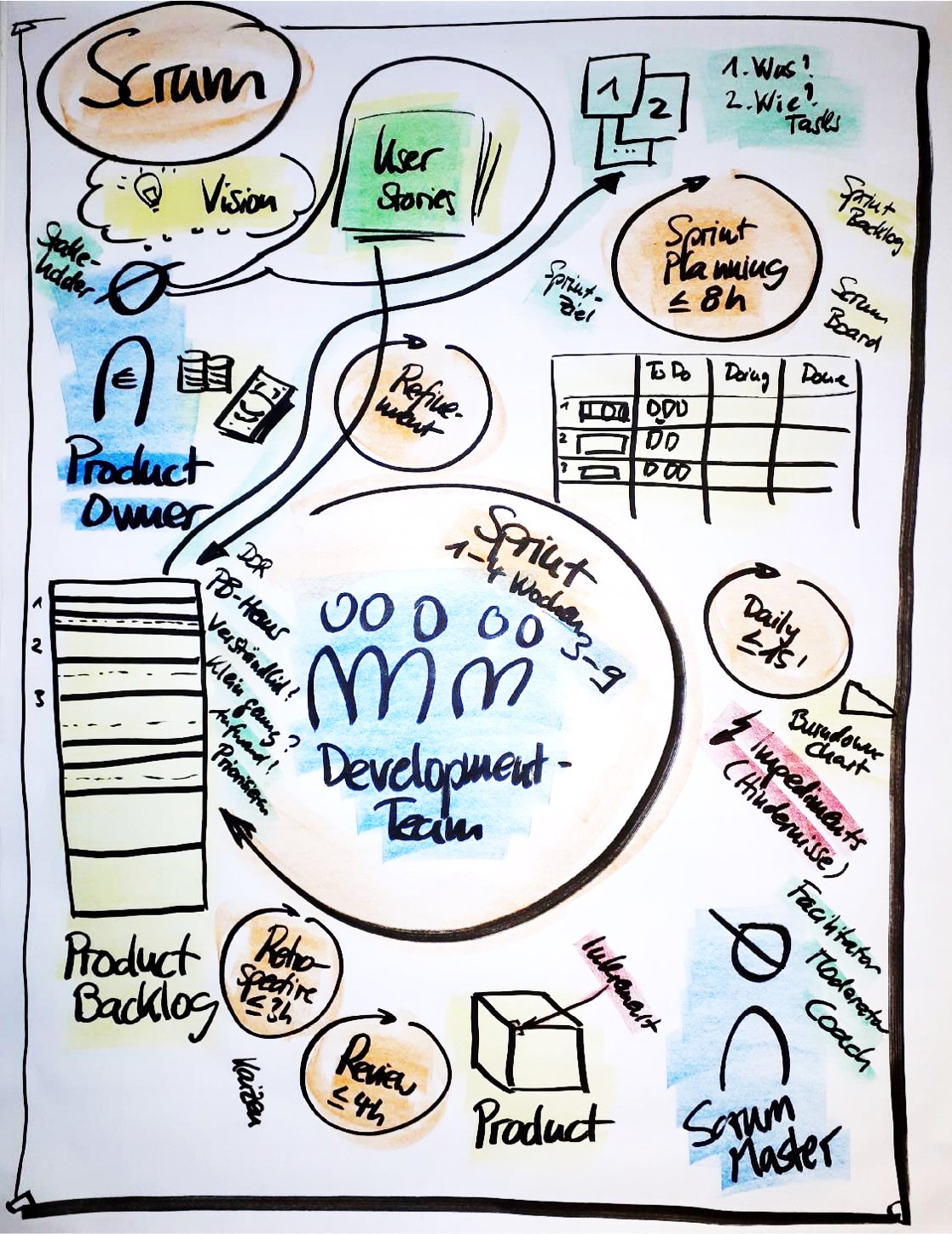
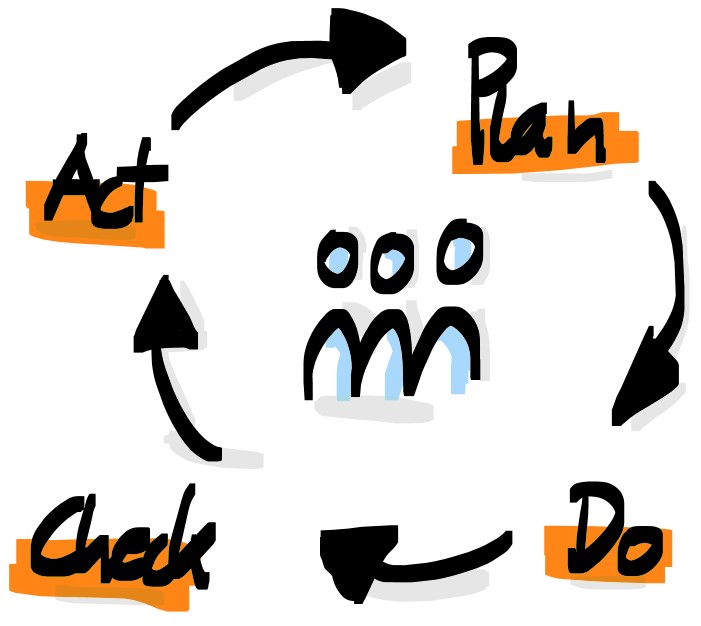 Dieses Phasen wiederholen sich ständig (also tatsächlich: unendlich). Ausschließlich alle agilen Arbeitsrahmen folgen diesem Zyklus, seien es nun Kanban, Design Thinking, DevOps und besonders natürlich Scrum.
Das ist sehr intuitiv
und entspricht unserer grundsätzlichen Lebenserfahrung, weshalb sich agile Arbeitsweisen Menschen sehr schnell vermitteln lassen.
Trotzdem tun sich Gruppen von Menschen, also: Teams, Abteilungen und Firmen oft schwer damit, sich nach diesem Prinzip zu strukturieren, zu organisieren und also: so zu arbeiten
Warum ist das so?
Zum einen lässt sich das wie bei jeder Veränderung mit Physik erklären, genauer: mit der Trägheit der Masse. Schließlich geht es darum, das Verhalten mindestens einer Gruppe zu verändern. Und meistens sogar das Verhalten von mehreren Gruppen von Menschen.
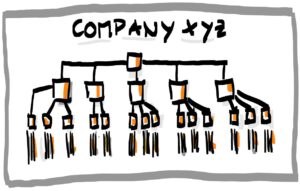
Zum anderen handelt es sich um einen relativ großen Wandel. Denn wir alle haben ein anderes Arbeiten internalisiert. Nämlich eines nach hierarchischen Entscheidungs- und Verantwortungsstrukturen.
Die folgen zwar auch dem PDCA-Zirkel
allerdings auf ganz andere Weise. Das „lernende“, antizipierende und vor allem aber entscheidende Mangement ist von den Lernerfahrungen der Umsetzungs-Teams heutzutage fast vollständig entkoppelt.
Heißt: Was an der „Arbeitsfront“ geschieht, also dort, wo die eigentliche Wertschöpfung stattfindet, wird nicht, spät und/oder nur stark gefiltert bei Geschäftsentscheidungen berücksichtigt.
Anders gesagt:
Das Management in hierarchisch strukturierten Unternehmen ist heute fast vollständig von den Produktionsprozessen entkoppelt. Was bitter ist. Denn die Produktions- und Serviceteams erledigen das eigentliche Geschäft, die eigentliche Wertschöpfung findet dort statt. Das, was den Kunden interessiert.
 Jetzt aber sollen alle gemeinsam daran arbeiten
 Jetzt aber sollen alle gemeinsam daran arbeiten
diesen unguten (und auch bedrohlichen) Zustand zu ändern und die Business- und die Umsetzungsperspektive wieder gut zu verzahnen.
Und zwar eben so, dass sie das – nunja – wirklich simple evolutionäre Prinzip von Lernen und Anpassen gemeinsam angehen. Zielgerichtet im Sinne der Unternehmung.
Also auch unter dem ständigen Diktat des Erfolgs, zu dem wir uns heutzutage verplichtet und manchmal auch gezwungen sehen. Was umgekehrt übrigens auch bedeutet, sprechen wir das ruhig einmal so offen und konkret aus:
Wir agieren heute immer unter sehr großer und hemmender Versagensangst. Tendenziell, versteht sich. Trotzdem hemmt uns das auch in der Veränderungsarbeit.
Sollen Menschen neue
und vielleicht sogar agile Handlungsmuster anwenden, brauchen sie immer erst einmal eine gute Antwort auf die Frage: Warum soll ich oder sollen wir das tun?
Denn: MENSCHEN SIND INTELLIGENT, vor allem emotional intelligent. Ja: ausnahmslos alle.
Warum also sollten sie den risikobehafteten Schritt tun
 Warum also sollten sie den risikobehafteten Schritt tun
und das hier und da wirklich nicht optimale, immerhin aber lange bewährte und auch halbwegs stabile und stabil-ausbalancierte, machtgestützte, hierarchische Silo-System mit einem unbekannten, also vermeintlich (!) unausgegorenen, instabilen, unsicheren, selbstorganisierten Gebilde austauschen?
Wo doch bislang alles funktioniert hat? Gut, wir ärgern uns zwar oft. Und eigentlich wissen wir, dass es hier und da wirklich nicht gut und schon gar nicht im Sinne des Kunden läuft. Aber immerhin läuft’s doch soweit, dass wir gut davon leben können. Warum also?
Das sind intelligente und sogar vernünftige Gedanken und Fragen, die – wie erwähnt – gute Antworten erfordern. Und auch Zeit, damit die Menschen die Antworten für sich finden und in ihren Arbeitsbereich auch nachvollziehbar integrieren können.
Einzelne Menschen und auch Gruppen
von Menschen (z.B. Organisationen) gehen immer dann neue Wege, wenn sie merken, dass sie mit dem, was und wie sie es bislang getan haben, nicht mehr weiterkommen. Sprich: Wenn sie keine andere Wahl mehr haben.
Menschen müssen also die aktuelle Situation als echte (!) Krise empfinden, die sie wirtschaftlich oder sonstwie existentiell oder in ihrem Selbstbild bedroht.
Ob Einzelne, Teams oder Unternehmen agil werden hängt daher von der jeweilig spezifischen Situation und vor allem vom Reifegrad ab.
In Unternehmen gibt es zu jeder Zeit viele unterschiedliche Perspektiven und Stände, was das anbelangt. Immer werden sich Menschen finden, die in dieser Hinsicht „etwas weiter sind“ als andere.
Doch weil Agilität eine Antwort auf eine allgemeine Entwicklung ist (auch, aber nicht nur am Markt), ist eher wahrscheinlich, dass es früher oder später in einer Organisation zur Weiterentwicklung in Richtung Agilität kommen wird. Befördert durch den stärker werdenden externen Druck, heute also des (vor allem digitalen) Wettbewerbs.
Dieser Hinweis scheint mir deshalb besonders angebracht:
 Dieser Hinweis scheint mir deshalb besonders angebracht:
Egal, ob Einzelperson oder Organisation, es geht gar nicht darum, agil zu werden! Sondern darum, die unternehmerischen Aufgaben kurz-, mittel- und langfristig möglichst gut zu erledigen. Mindestens so also, dass die Unternehmung überlebt.
Dazu wird zum einen sehr nötig sein
das bestehende Geschäft mit den passenden Abläufen und Strukturen solange am Laufen zu halten, so lange sie tragen. Sicherlich werden dafür weiterhin die bestehenden, stabilen Prozesse gebraucht.
Mit der Zeit und dann immer dringender werden Unternehmen aber auch Veränderungen am Markt schneller zu antizipieren haben als sie es heute tun und auch in der Lage sind zu tun. Organisationen werden dann nicht um agilere Organisationsstrukturen herumkommen.
Und dann werden noch bessere Voraussetzungen gegeben sein, die den Menschen erlauben, (wieder) so zu arbeiten, wie sie eigentlich sind: Agil.
Weiterlesen?
- Appelo, Jurgen: How to Change the World. Change Management 3.0.
- Demingkreis. Wikipedia-Eintrag: https://de.wikipedia.org/wiki/Demingkreis
- Kotter, John P.: Accelerate. Strategischen Herausforderungen schnell, agil und kreativ begegnen
- Laloux, Frederic: Reinventing Organizations. Ein Leitfaden zur Gestaltung sinnstiftender Formen der Zusammenarbeit.
- Senge, Peter M.: Die fünfte Disziplin. Kunst und Praxis der lernenden Organisation.
- Cynefin – Weaving Sense-Making into the Fabric of Our World
- „Ressourcen für Innovation schaffen.“ Das Branchenmagazin „Buchreport“ im Interview mit Edgar Rodehack: https://www.buchreport.de/news/pp-ressourcen-fuer-innovation-schaffen-kampfaufgabe-fuer-verlage
- Roth, Gerhard: Persönlichkeit, Entscheidung und Verhalten. Warum es so schwierig ist, sich und andere zu ändern.
You are supposed to work Agile? You want to do it yourself? Maybe you have already made a few first agile attempts to go? But now you still have a few questions? You are not alone. I, for instance, have recently been asked:
Agility – Can Anyone Do It?
Individuals don’t have to become Agile.
They already are, each and every one of us. Agile, after all, means learning. Or better yet: Successfully adapting. And if people can do something – at least in principle – then it is this.
The answer is therefore: Yes. Anyone can do Agile.
And that without anything having to be done or could be done to it. This is provided by the evolutionary „operating system“ with which we all are born.
One of the most central principles of Agility
is the PDCA circle, also known as the „Deming circle.“ It consists of the following four phases: 1. planning, 2. doing, 3. checking (studying), 4. adjusting (or acting).
These phases are constantly repeating (in fact: infinitely). All Agile frameworks follow this cycle. Be it Kanban, Design Thinking, DevOps, and especially of course Scrum.
This is very intuitive
and is in line with our basic life experience, which is why Agile ways of working are very easy to introduce to people.
Despite it often is difficult for groups of people, ie: teams, departments, and companies to structure themselves according to this principle, to organize and therefore: to work this way.
Why is that?
First, as with any change, it can be explained by physics, or more precisely, by the inertia of mass. After all, it is about changing the behavior of at least one group. And usually even the behavior of several groups of people.
Second, it is a relatively large change. Because we have all internalized a different way of working. Namely, one according to hierarchical decision-making and responsibility structures.
They do follow the PDCA circle as well.
However in a completely different way. Learning“, anticipating and, above all, decision-making management is nowadays almost completely detached from the learning experiences of the implementation teams.
This means: what happens on the „work front“, that is, where the actual value creation takes place, is not taken into account at all, is taken into account late and/or is only taken into account in a heavily filtered manner when making business decisions.
In other words:
Today, management in companies with a hierarchical structure is almost completely disconnected from production processes. Which is tough. Because the production and service teams do the real work, the real value creation takes place there. The stuff that interests the customer.
But now everyone should work together to
to change this unfortunate (and also threatening) state and to interlock the business and the implementation perspective in a good way again.
Just in such a way that they approach the – well – really simple evolutionary principle of learning and adapting together . in the sense of the company.
This means also under the permanent dictate of success, to which we see ourselves nowadays obligated and sometimes also forced. Which conversely also means, by the way, let’s speak that calmly so open and concretely for once:
Today we tend to operate under a very great and inhibiting fear of failure.Nevertheless, this also inhibits us in the change work.
If people want to apply new
and perhaps even agile patterns of behavior, first of all they always need a good answer to the question: Why should I or we do this?
Because: HUMANS ARE INTELLIGENT, especially emotionally intelligent. Yes: ALL of them, without exception.
So why should they take the risky step
and exchange the really not optimal, but nevertheless, long proven and also halfway stable and stable-balanced, power-supported, hierarchical silo system with an unknown, therefore supposedly (!) half-baked, unstable, insecure, self-organized entity?
When everything has worked so far? Well, we are often frustrated. And we actually know that things are really not going well here and there, certainly not in the interests of the customer. But at least it’s going well enough that we can make a good living from it. So why?
These are intelligent and even reasonable thoughts and questions, which – as mentioned – require good answers. And also time, so that people can find the answers for themselves and also integrate their workspace in a comprehensible way.
Individuals and also groups
of people (e.g. organizations) always take new paths when they realize that they can no longer get ahead with what and how they have done it so far. In other words: When they no longer have any other choice.
Therefore, people must feel the current situation as a real (!) crisis, which threatens them economically or otherwise existentially or, for instance, in their self-perception.
Whether individuals, teams or companies turn Agile depends, therefore, on the specific situation and, above all, on the degree of maturity.
In companies, at any time, there are many different perspectives and stands, as far as that is concerned. There always will be people who are „a little further along“ in this regard than others.
But because Agility is a response to a general development (also, but not only in the market), it is more likely that sooner or later there will be an evolution in an organization towards Agility. Promoted by the increasing external pressure, today that is of the (especially digital) competition.
This hint seems particularly appropriate to me for that reason:
Whether individual or organization, it’s not about becoming Agile at all! But about doing the business tasks as well as possible in the short, medium and long term. At least so that the company survives.
That is why, on the one hand, it will be very necessary
.
to keep the existing business running with the appropriate processes and structures as long as they carry. Certainly, the existing, stable processes will continue to be needed for this.
However, over time and then more urgently, companies will have to anticipate changes in the market more quickly than they do today and are able to do. Organizations will then have no option but to adopt more Agile organizational structures.
And then there will be even better conditions that allow people to work (again) as they actually are: Agile.
What Else Comes To My Mind?
- Appelo, Jurgen: How to Change the World. Change Management 3.0.
- Demingkreis. Wikipedia-Eintrag: https://de.wikipedia.org/wiki/Demingkreis
- Kotter, John P.: Accelerate: Building Strategic Agility for a Faster-Moving World
- Laloux, Frederic: A Guide to Creating Organizations Inspired by the Next Stage in Human Consciousness: A Guide to Creating Organizations Inspired by the Next Stage of Human Consciousness
- Senge, Peter M.: The Fifth Discipline
- Cynefin – Weaving Sense-Making into the Fabric of Our World
- „Ressourcen für Innovation schaffen.“ Das Branchenmagazin „Buchreport“ im Interview mit Edgar Rodehack: https://www.buchreport.de/news/pp-ressourcen-fuer-innovation-schaffen-kampfaufgabe-fuer-verlage
- Roth, Gerhard: Persönlichkeit, Entscheidung und Verhalten. Warum es so schwierig ist, sich und andere zu ändern.