Gerne haben wir Menschen es sicher. Deshalb versuchen wir oft möglichst viel zu kontrollieren. Ist das eine gute Strategie oder sitzen wir einer Kontroll-Illusion auf?
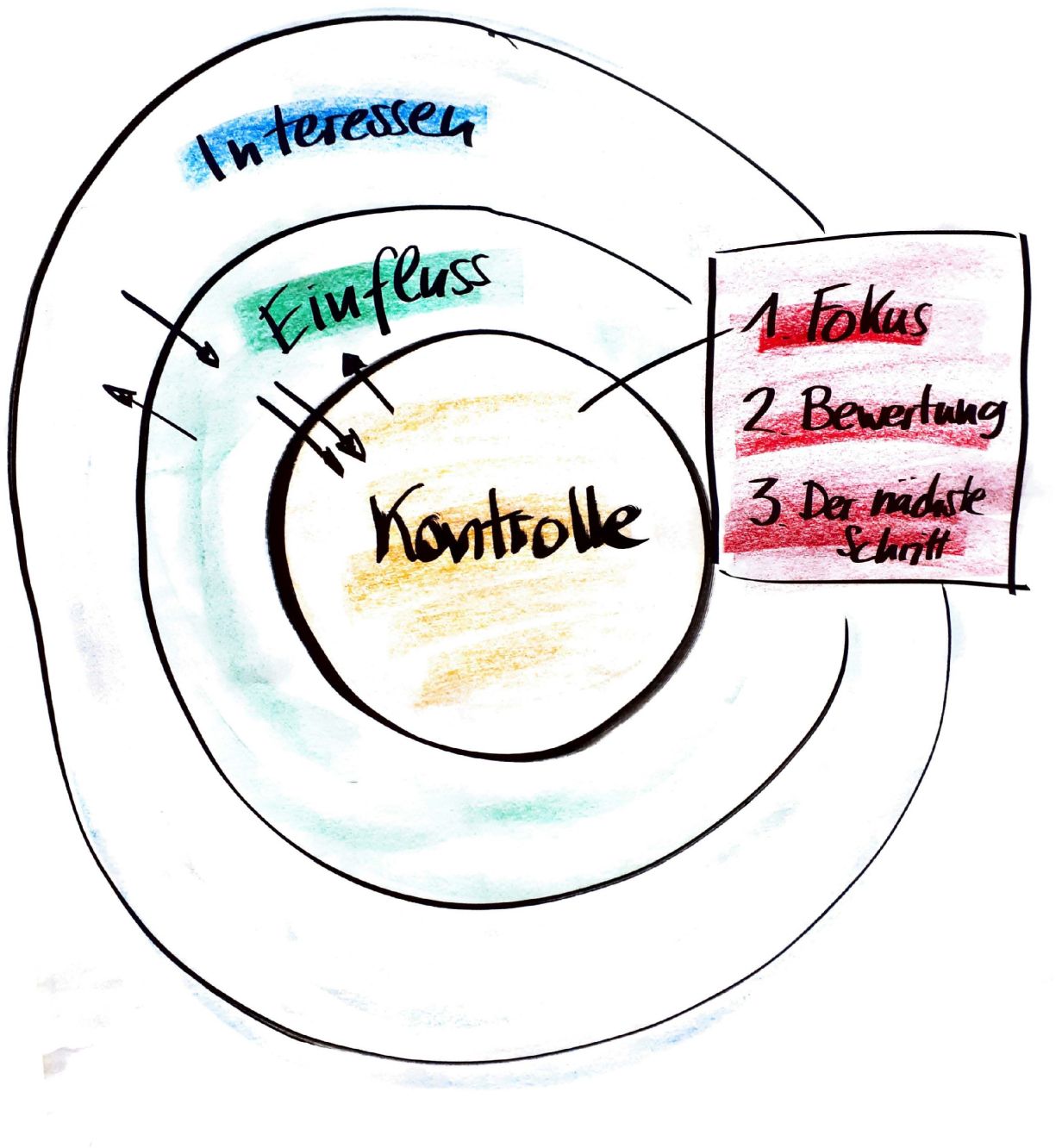
Um die Frage zu beantworten, inwiefern Kontrolle als Strategie wirklich zielführend ist, ist ein Sphärenmodell hilfreich, das den Handlungsspielraum von Menschen in die Bereiche Kontrolle, Einfluss und Interessen aufteilt:
1. Kontrolle
Der Kontrollbereich ist der Kern des souveränen individuellen Handelns, gewissermaßen das Königreich des Einzelnen. Hier kann jede und jeder stets frei denken und entscheiden, was sie oder er möchte und für richtig hält. /1/
Durch das, wie sich Menschen innerhalb ihres Kontrollbereichs verhalten, nehmen sie Einfluss auf ihre Umwelt und das Geschehen um sie herum. Das gelingt immer nur indirekt durch Impulse, die in den angrenzenden Einflussbereich gesendet werden.
Das Ziel ist stets, dass sich die Dinge so entwickeln, wie sie es sich wünschen (zum Beispiel: „Ich will dieses Jahr nach Island in Urlaub!“).
2. Einfluss
Der Einflussbereich ist der direkte Nachbar des Kontrollbereichs. Und von dort wird er auch permanent „bearbeitet“. („Schatz, was hältst du von einer Reise nach Island? Das wäre doch mal eine schöne Abwechslung.“)
Weil meistens mehrere Menschen und Institutionen am selben Einflussbereich angrenzen, entwickelt sich eine wechselseitige soziale Dynamik, die mit „komplex“ treffend beschrieben ist.
Denn der Einflussbereich reagiert auf die Impulse und nimmt im Gegenzug seinerseits Einfluss auf die angrenzenden (Kontroll-) Bereiche der jeweilig Beteiligten. („Island? Warum eigentlich nicht? Ja, das wäre was.“ – „Was?! Island?! Mama, Papa, Ihr habt uns doch letztes Jahr versprochen, dass wir nach Italien an den Strand fahren! Island könnt Ihr vergessen!“) /2/
3. Interessen
Außerhalb des Einflussbereichs ordnet sich der Interessensbereich an, der als genereller Rahmen für die Kontroll- und Einflussdynamik fungiert.
Was hier geschieht, hat mehr oder minder große Bedeutung und oft sogar konkrete Auswirkungen auf das Leben und die Möglichkeiten der Einzelnen. Ohne allerdings, dass diese ihrerseits die Geschicke in diesem Bereich direkt, unmittelbar oder überhaupt beeinflussen könnten. (Ein Beispiel hierfür ist der überraschende Ausbruch z.B. des isländischen Vulkans Eyjafjallajökull, der eine geplante Urlaubsreise verhindern kann).
Wenn es für einzelne Menschen eine Möglichkeit gibt, im Interessensbereich etwas zu ändern, wird dies immer nur indirekt gelingen: Durch Aktionen aus dem Kontrollbereich und die „Brücke“ Einflussbereich.
Hohe Sicherheit also durch möglichst viel Kontrolle?
Dazu scheint es wenig zu geben, was wir Menschen direkt steuern können. Bei Lichte betrachtet sind es nur diese drei Schritte:
1. Wahl des Fokus:
Worauf blicken wir im aktuellen Moment? Worauf konzentrieren wir uns (jetzt)? Ist das wirklich so wichtig (jetzt oder generell), als dass wir uns damit beschäftigen sollten?
2. Bewertung:
Wie bewerten wir das, was wir gerade sehen, hören, erleben? Ist das kurz-, mittel- und langfristig so wichtig, als dass wir uns damit beschäftigen?
3. Der nächste Schritt:
Was tun wir jetzt im Rahmen unserer Möglichkeiten, um den Lauf der Dinge so zu beeinflussen, dass sie sich kurz-, mittel- und langfristig in unserem Sinne entwickeln?
 Diese drei Schritte mögen wenig erscheinen.
 Diese drei Schritte mögen wenig erscheinen.
Aber sie haben es in sich. Und sie sind unsere einzige Chance, unsere volle Entscheidungs- und Bewegunsfreiheit zu leben und möglichst sicher Erfolg zu haben. Deshalb ist sinnvoll, diese Schritte so gut wie möglich zu gehen. Also möglichst achtsam, bewusst und konzentriert.
Anmerkungen
/1/ Sofern die individuellen und z.B. durch Erfahrungen geprägten psycho-biologischen Automatismen und Muster dies zulassen.
/2/ Übrigens immer mit offenem Ausgang. Was hier genau geschieht, lässt sich wegen der vielen verschiedenen Beteiligten und Optionen nicht vorhersagen. Komplex eben.
Literatur
/1/ Hoodguin, Lex: Decision Making in a Complex World. MOOC-Kurs (Futurelearn.com), University of Groningen: https://www.futurelearn.com/courses/complexity-and-uncertainty
/2/ Hüther, Gerald: Biologie der Angst. Wie aus Streß Gefühle werden.
/3/ Johner, Philipp: Transforming leaders. Top-Management und Transformation. So werden Sie nachhaltig erfolgreich, steigern die Mitarbeiterzufriedenheit und sparen Kosten.
/4/ Ausbruch des Eyjafjallajökull 2010 – Wikipedia-Eintrag
Peole like to be safe. That’s why we often try to be in control as much as possible. Is this a good strategy or just an illusion?
In order to clarify whether and to what extent control is a really effective strategy, it is helpful to use a sphere model that divides people’s scope of action into the areas of control, influence, and interests:
1. Control
The control sphere is the core of sovereign individual action, the kingdom of the individual, so to speak. This is where everyone is free to think and decide at all times what he or she wants and believes to be right. /1/
By acting within their sphere of control and how they do so, people influence their environment and what happens around them. However, people only ever manage to do this indirectly through impulses sent to the neighboring sphere of influence.
The goal is always that things develop in such a way, as humans wish it. Example: “ This year, I want to go to Iceland for vacation!“.
2. Influence
The area of influence is the direct neighbor of the control area. And from there it is also permanently “ worked on „. („Honey, what do you think about a trip to Iceland? That would be a nice change.“)
Since usually several people and institutions are adjacent to the same sphere of influence, a mutual social dynamic develops, which is appropriately described as „complex“.
Because the sphere of influence reacts to the impulses and takes in turn influence on the neighboring (control) areas of the respective participants. („Iceland? Why not actually? Yes, that would be nice.“ – „What?! Iceland?! Mom, Dad, you promised us last year that we go to Italy to the beach! Iceland forget it!“) /2/
3. Interests
Outside the sphere of influence is the area of interest, which provides the general framework for the dynamics of control and influence.
What happens here has great significance and often even concrete effects on the lives and opportunities of individuals. Without, however, being able to influence this area directly, immediately, or at all on their part. (An example of this is the surprising eruption, for example, of the Icelandic volcano Eyjafjallajökull, which can prevent a planned vacation trip.)
If there is a possibility for individuals to change something in the sphere of interest, this will always succeed only indirectly: Through actions from the sphere of control and the „bridge“ of influence.
So can one gain high levels of certainty through as much control as possible?
There seems to be little that we can directly control. Actually, it’s just these three steps:
1. Choice of Focus:
What are we looking at in the current moment? What are we focusing on (now)? Is it really that important (now or in general) that we should be bothered with it?
2. Evaluation:
How do we evaluate what we are seeing, hearing, experiencing right now? Is it so important in the short, medium, and long term that we should spend time and energy on it?
3. Next step:
What are we doing now, within our means, to influence the course of events so that they develop in our favor in the short, medium and long term?
These three steps may seem few.
But they are powerful.And they are our only chance to live our full freedom of choice and succeed with the utmost certainty. That’s why it makes sense to take these steps as best we can. That is, as mindful, aware and focused as possible.
Notes
/1/ Provided that the individual and, for example, by experience shaped psycho-biological automatisms and patterns allow this.
/2/ By the way, always with an open outcome. What exactly happens here cannot be predicted because of the many different participants and options. Simply complex.
Literature
/1/ Hoodguin, Lex: Decision Making in a Complex World. MOOC-Kurs (Futurelearn.com), University of Groningen: https://www.futurelearn.com/courses/complexity-and-uncertainty
/2/ Hüther, Gerald: Biologie der Angst. Wie aus Streß Gefühle werden.
/3/ Johner, Philipp: Transforming leaders. Top-Management und Transformation. So werden Sie nachhaltig erfolgreich, steigern die Mitarbeiterzufriedenheit und sparen Kosten.
/4/ Eyjafjallajökull – Wikipedia