Sie sind dazu verdonnert worden, agil zu arbeiten? Sie wollen es sogar selbst? Allerdings haben Sie noch ein paar Fragen? Sie sind nicht allein. Ich bin zum Beispiel neulich gefragt worden:
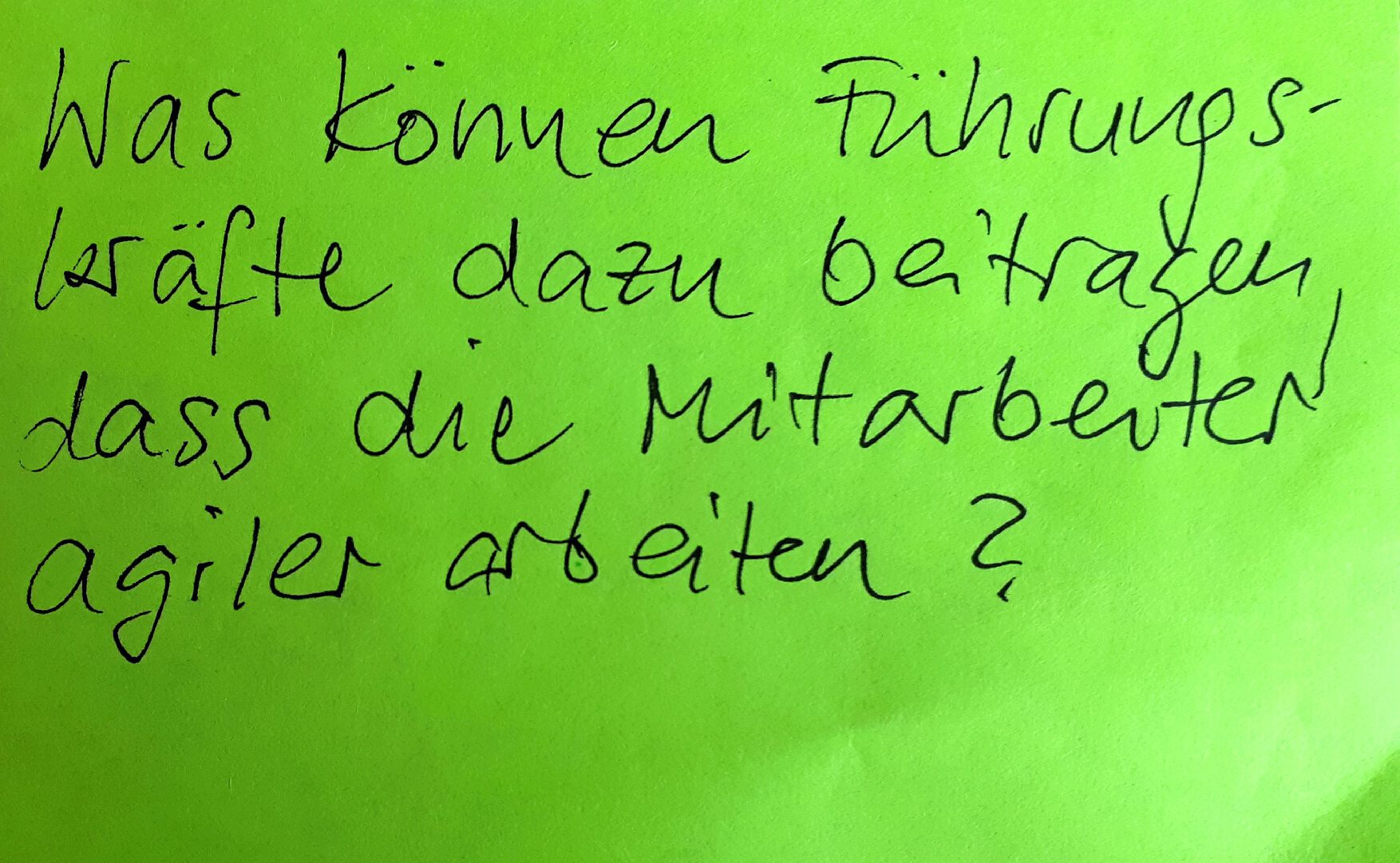
Was können Führungskräfte dazu beitragen, dass ihre MitarbeiterInnen agiler arbeiten?
Als erstes braucht es die überzeugte Erkenntnis
dass Manager keine Menschen managen. Sie managen das System. Und von dem sind sie selbst ein Teil. Das heißt:
Nicht die MitarbeiterInnen arbeiten agiler. Alle arbeiten agiler: Mitarbeitende und Führungskräfte. We are all in this together!
Und weil Führungskräfte mit der Art und Weise, wie sie agieren, die Kultur besonders prägen, sollten gerade die Führungskräfte mit gutem Beispiel vorangehen. Heißt: Zuerst damit anfangen.
Und zwar nicht nur im Sprechen. Sondern vor allem auch: Im TUN.
Also ist hilfreich
so schnell es geht in agile Routinen zu finden (mit allem, was dazugehört, also z.B. auch Transparenz…) und z.B. Retrospektiven abzuhalten. Und das nicht als Einmal-Event, sondern konsequent immer wieder!

Außerdem sollten sie
einen Company-Backlog aufbauen. Oder zumindest eine verständliche, fundierte, belastbare, aussagekräftige Projektliste zusammentragen. Also: Mit ALLEN Projekten, an welchen in der Unternehmung gerade gearbeitet wird, was man sich davon verspricht und was das Invistitionsrisiko ist (und zwar das wirkliche und nicht das geschätzte oder unter- bzw. übertriebene).
Nur so als Idee. Das ist nach meiner Erfahrung jedenfalls ein guter Start. (Das Fehlen dieser Informationen oder eines Backlogs fällt aber beim Abhalten von Retrospektiven ohnehin sehr schnell auf.)
Grundsätzliche Aufgabe aller agiler Führungskräfte aller Ebenen (!)
ist dabei ausschließlich, Ziele und Rahmen so zu setzen, so dass die Ergebnisse der operativ arbeitenden Teams möglichst schnell und möglichst wertschöpfend erarbeitet werden können. Heißt: Kundenzentriert und rentabel .
Dazu gehört NICHT, den Teams ihre vermeintlichen Defizite vorzuhalten oder Druck zu machen. Dazu gehört auch NICHT Besserwisserei oder Statusgedöns. Denn das ist für ALLE Geschäftsziele SEHR HINDERLICH.
Aufgabe des agilen Managements ist
zu erklären, was genau gemacht werden soll (Projekte/Aufgaben) und vor allem auch warum und mit welchen Zielsetzungen und Erwartungen.
Außerdem gehört dazu, zu sagen, WAS WIE WICHTIG ist, damit die operativen Teams wissen, in welcher Reihenfolge sie genau was anzugehen haben. (Das Wichtigste zuerst.)

Agile Führungskräfte vertrauen also
auf die Expertise ihrer Teams – wofür sie nicht nur nebenbei bemerkt SEHR viel Geld zahlen – und setzen also „nur“ den organisatorischen, strukturellen Rahmen. Was eine wirklich herausfordernde Arbeit ist.
Die Mitarbeitenden in den Teams können so möglichst frei und ungestört in ihrer Expertenrolle die Ergebnisse erarbeiten, die Kunden, Inhaber und Management erwarten.
Ohne Wechselkosten. Ohne Verzugskosten. Ohne Stress oder sonstigen seelischen Nöte.
Störungen und sonstige Hindernisse für die Teams
die sie nicht alleine aus der Welt schaffen können, MÜSSEN von den Führungskräften aus dem Weg zu räumen. Was könnte das sein? Naja, z.B. Sitzungen abzusagen oder so abzuhalten, dass sie effektiv sind.
Nochmal: Sitzungen, die aus Gewohnheit oder Statusgründen einberufen oder auch nur verlängert werden, VERNICHTEN WERTSCHÖPFUNG und setzen den Unternehmenserfolg auf’s Spiel. Und deshalb lassen wir das einfach sein!
 Agiles Führen ist etwas anderes
 Agiles Führen ist etwas anderes
als das, was wir gemeinhin unter klassischem Management verstehen. Andersherum sind so genannte klassische ManagerInnen, mit denen ich zu tun habe, auch oft gar keine klassischen Manager.Im Gegenteil freuen sie sich, dass sie sich in einer agilen Transition zum „Agile“ oder „Servant“ Leader entwickeln können und – END-LICH! – das tun können, was sie immer schon tun wollten: Zum Unternehmenserfolg beitragen.
Weiterlesen?
- Appelo, Jurgen: Management 3.0. Leading Agile Developers, Developing Agile Leaders.
- Heiler, Stephan; Borck, Gebhard: Chef sein? Lieber was bewegen! Warum wir keine Führungskräfte mehr brauchen.
- Laloux, Frederic: Reinventing Organizations: Ein Leitfaden zur Gestaltung sinnstiftender Formen der Zusammenarbeit
- Logan, Dave: Tribal Leadership.
- Rother, Mike: Die Kata des Weltmarktführers. Toyotas Erfolgsmethoden.
You’ve been ordered to work Agile? You even want it yourself? However, you still have a few questions? You’re not alone. For example, I was recently asked:
What can managers do to help employees work more Agile?“
The first thing needed is that management realises with conviction
that managers don’t manage people. They manage a system. A system of which they are a part themselves. That is:
It’s not the employees who work more agile. EVERYONE is working more agile: Employees AND managers. Because we are all in this together!
And because leaders are particularly influential in shaping the culture with the way they act, leaders in particular should lead by example. Meaning: Start with working Agile first.
And this not only in speaking. But above all also: in DOING.
So being helpful would be
to get into Agile routines as quickly as possible (with everything that goes with it, so e.g. transparency…) and to conduct retrospectives, for example. Not as a one-time event, but consistently over and over again!
In addition, consider
to establish a company backlog. Or at least compiling a comprehensible, well-founded, reliable, descriptive project list. With ALL projects, which are currently being worked on in the company, what is expected from these projects and what is the investment risk (the real one and not the estimated or under- or overestimated one).
Just as an idea. In my experience, that is a good start. ( However, lacking of this information or having no backlog is very quickly noticed when holding retrospectives anyway)
A fundamental task of all Agile leaders at all levels (!)
is exclusively to set goals and frameworks in such a way that the results of the operationally working teams can be produced as quickly and as value-adding as possible. Meaning: This needs to be done VERY customer-centric and in a profitable manner.
This does NOT include blaming teams for their perceived shortcomings or putting pressure on them. It also does NOT include know-it-all attitude or status buzz. Because that is VERY HARMFUL for ALL business goals.
The responsibility of agile management is
to explain what exactly is to be done (projects/tasks) and, most importantly, why and with what objectives and expectations.
Also, part of this is to say exactly WHAT is HOW IMPORTANT, so that the operational teams know to tackle exactly what in which order. (First things first.)
Agile leaders trust
the expertise of their teams – for which they pay a VERY large amount of money, not incidentally – and thus „only“ set the organizational, structural framework. Which is a really challenging job.
Thus, the employees in the teams can work as freely and undisturbed as possible in their expert roles to produce the results that customers, owners and management expect.
Without switching costs. Without costs of delay. Without stress or other mental distress.
Disruptions and other impediments for teams
that they can’t clear on their own MUST be removed by leaders. What might that be? Well, such as canceling meetings or hosting them in a way that makes them effective.
Once again, meetings that are called or even extended for habit or status reasons DESTROY ADDING VALUE and put company success at risk. And that’s why we simply don’t do it!
Managing and leading in an Agile way is totally different
to what we commonly think of as classical management. On the other hand, many so-called classical managers I deal with are also often not classical managers at all.On the contrary, they are happy that in an Agile transition they can become an „Agile“ or „Servant“ leader and – FINALLY! – be able to do what they have always wanted to do: Contribute to the company’s success.
Read more?
- Appelo, Jurgen: Management 3.0. Leading Agile Developers, Developing Agile Leaders.
- Heiler, Stephan; Borck, Gebhard: Chef sein? Lieber was bewegen! Warum wir keine Führungskräfte mehr brauchen.
- Laloux, Frederic: Reinventing Organizations: A Guide to Creating Organizations Inspired by the Next Stage in Human Consciousness
- Logan, Dave: Tribal Leadership.
- Rother, Mike: Toyota Kata: Managing People for Improvement, Adaptiveness and Superior Results