Sie möchten oder sollen agil arbeiten? Jetzt stellen sich Ihnen noch ein paar Fragen? Sie sind nicht allein. Zum Beispiel bin ich letztens gefragt worden:
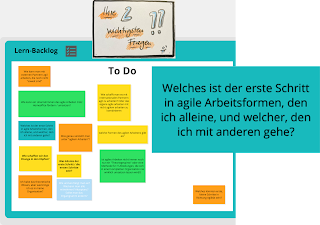
Welches ist der erste Schritt in agile Arbeitsformen, den ich alleine, und welcher, den ich mit anderen gehe?

Erstens: Für Sie persönlich
Machen Sie sich klar, dass AGILITÄT EIN TEAMSPORT ist. Soll heißen: Selbst wenn Sie noch so gut über Agilität Bescheid wissen, Sie werden mit all Ihrem Wissen und Ihren Fähigkeiten alleine nicht weit kommen.
Die beste Grundsatzlektüre, die ich dazu kenne,
ist (ich wiederhole mich, ich weiß): Der Scrum-Guide. Der erklärt Ihnen das Spiel, die Mannschaftsaufstellung und die grundsätzliche Taktiken – um im Bild des Teamsports zu bleiben.
 Aus meiner Sicht reicht das. Mehr braucht es dazu (erstmal) aus meiner Sicht wirklich nicht. Für den Fall aber, dass Sie das anders sehen, Ihnen der Scrum Guide also nicht reichen sollte, lesen sie den Scrum Guide gerne noch einmal. Und dann ggf. auch andere Literatur, z.B. über Kanban (Literaturangaben weiter unten).
Dann aber sollten Sie schnellstmöglich
Zweitens: Starten Sie, indem Sie gemeinsam regelmäßig eine Retrospektive machen

- Was ist SEIT DER LETZTEN RÜCKSCHAU organisatorisch gut gelaufen? Was weniger?
- Was lernen wir daraus generell? Was lernen wir daraus FÜR DIE NÄCHSTEN WOCHEN?
- Welche machbare Maßnahme fällt uns für die nächsten Wochen ein, die uns ein bisschen besser macht?
Bei der regelmäßigen Retrospektive fällt schnell auf, wie Sie sich als Team verbessern können, was Ihnen noch fehlt und welche methodischen Hilfsmittel Ihnen aus der agilen (oder sonsteiner) Welt helfen können.
Wichtig: Wenn Ihr Team eine gewissen Reife hat – damit ist gemeint, dass die meisten schon erkannt haben, dass es wie bisher nicht weitergehen KANN -, dann sind Sie damit nicht erst auf dem Weg, agiler zu WERDEN. Dann SIND sie es schon.

Natürlich können Sie auch
Der Nachteil: Sie haben mit allem Positiven und Negativen zu rechnen, was Sie aus anderen Veränderungsinititativen kennen. Und das sind eben oft nicht nur Jubelschreie, sondern meist auch die (im Grunde vernünftige) generelle Frage: „Was soll denn das jetzt? Haben wir nicht Wichtigeres zu tun?“
 Selbst wenn Ihre Antwort generell „Nein“ heißt
 Selbst wenn Ihre Antwort generell „Nein“ heißt
Literatur
- Anderson, David J.; Reinertsen, Donald G: Kanban. Successful Evolutionary Change for Your Technology Business.
- Appelo, Jurgen: How to Change the World.
- Laloux, Frederic: Reinventing Organizations. A Guide to Creating Organizations. Inspired by the Next Stage of Human Consciousness.
- Rodehack, Edgar: Die acht Schritte eines Sprintübergangs.
- Sutherland, Jeff: Scrum. The Art of Doing Twice the Work in Half the Time, New York, 2014. (Deutsch: Die Scrum-Revolution)
- Schwaber, Ken; Sutherland, Jeff: Scrum Guide
- Wohland, Gerhard; Wiemeyer, Matthias: Denkwerkzeuge der Höchstleister. Warum dynamikrobuste Unternehmen Marktdruck erzeugen.
You like or should work in an Agile way? Now you still have a few questions? You are not alone. For example, I was asked the other day:
Which is the first step into agile working forms that I take alone, and which one that I take with others?
Firstly: For you personally
Understand that AGILITY IS A TEAM SPORT. In other words, even if you know as much as you can about Agile, you won’t get far on your own despite all your knowledge and skills.
The best fundamental reading I know on the subject of Agile,
(I repeat myself, I know): The Scrum Guide. It explains the game, the team formation and the basic tactics – to stay in the image of team sports.
From my experience, that’s enough. That’s all it really needs (for now). However, in case you see it differently, i.e. if the Scrum Guide is not enough for you, you are welcome to read the Scrum Guide again. And then, if necessary, also other literature, e.g. about Kanban (references below).
But then you should as soon as possible
Second: Start by doing regular retrospectives together
- What has gone well in terms of organisation SINCE THE LAST RETROSPECTIVE? What gone not so well?
- What do we learn from this in general? What is the learning for our planning of the THE NEXT COUPLE OF WEEKS?
- What doable measure can we think of for the next few weeks that will make us a little better?
During the regular retrospective, it quickly becomes apparent how you can improve as a team, what you are still lacking and which methodological tools can help you from the agile (or other) practices.
Important: If your team has a certain maturity – by this is meant that most of them have already realised that things CAN’T go on as before – then you are not just on the way to BECOMING more Agile. Then you ARE already.
Of course, you can also
Disadvantage: You have to reckon with everything positive and negative that you know from other change initiatives. And these are often not only cheers, but also the (basically reasonable) general question: „What is this all about? Don’t we have more important things to do?“
Even if your answer to this question in general is “ No“
Literatur
- Anderson, David J.; Reinertsen, Donald G: Kanban. Successful Evolutionary Change for Your Technology Business.
- Appelo, Jurgen: How to Change the World.
- Laloux, Frederic: Reinventing Organizations. A Guide to Creating Organizations. Inspired by the Next Stage of Human Consciousness.
- Rodehack, Edgar: Die acht Schritte eines Sprintübergangs.
- Sutherland, Jeff: Scrum. The Art of Doing Twice the Work in Half the Time, New York, 2014. (Deutsch: Die Scrum-Revolution)
- Schwaber, Ken; Sutherland, Jeff: Scrum Guide
- Wohland, Gerhard; Wiemeyer, Matthias: Denkwerkzeuge der Höchstleister. Warum dynamikrobuste Unternehmen Marktdruck erzeugen.