Es gibt nichts praktischeres als eine gute Theorie.
Bevor wir end-lich! darüber sprechen, was all diese theoretischen Erkenntnisse denn so praktisch macht, ist noch ein kleiner Hinweis darauf wichtig, welche Arten von Systemen es eigentlich gibt.
Einfach – Kompliziert – Komplex – Chaotisch
- Im zweiten Teil der kleinen Serie hatte ich bereits über einfache, komplizierte und komplexe Systeme gesprochen. Sie unterscheiden sich darin, wie ihre Ursache – Wirkungszusammenhänge im Innenleben organisiert sind.
Statisch – Dynamisch
- Statische Systeme sind einfache, unflexible Einheiten: Einmal installiert, verändern sie sich nicht mehr. Beispiel dafür wären einfache Input-X-Output-Y-Automaten (z.B. Kaffeemaschine).
- Dynamische Systeme sind sich verändernde, flexible Einheiten. Sie sind in der Lage, sich wandeln. Teilweise aus innerem Antrieb, teilweise aufgrund von externen Impulsen. Beispiele für ultradynamische Systeme sind Wetterphänomene.
Tot – Lebendig/Lernend – Nicht-lernend (dumm)
- Lebende Systeme sind tendenziell dynamische Systeme. Eben solche, die von sich aus eine gewisse Selbsterhaltungs- oder sogar Wachstumsdynamik entwickeln.
- Tote Systeme führen dagegen ausschließlich jene Operationen aus, die ihnen zu eigen ist. Sonst nichts.
- Insofern kann auch von lernenden und nicht-lernenden, quasi dummen Systemen gesprochen werden.
Für mich am hilfreichsten ist die Unterscheidung in FRAGIL und ANTIFRAGIL (Nassim Taleb).
Fragil – Antifragil
- Fragil
- Statische Systeme, die sich nicht weiterentwickeln oder lernen (können), sind fragil. Denn durch ihre mangelnde Flexibilität sind sie stets gefährdet, durch Erschütterungen oder Impulse von Innen oder Außen beschädigt zu werden.
- Also müssen sie entweder von Außen davor geschützt werden. Oder sie müssen ultrastabil aufgebaut sein bzw. so ausgestattet, dass ihnen innere oder äußere Impulse nichts anhaben können.
- Beides ist oft aufwendig und teuer. (Und es lenkt oft vom eigentlichen Vorhaben ab.)
- Als Beispiel für ein fragiles System dient Taleb eine Porzellantasse, die z.B. für den Transport in eine stoßgeschützte Verpackung gesteckt wird.
- Antifragil
- Antifragile Systeme sind im absoluten Gegensatz dazu dynamisch und lernend – und zwar aus sich selbst heraus.
- „Stressende“ Erschütterungen machen ihnen also nicht nur nichts aus (im Gegensatz zur Porzellantasse). Antifragile Systeme werden dadurch sogar besser, intelligenter, schlauer und auch überlebensfähiger.
- Beispiele: Alle lebende und lernende Organismen (bis zu einem bestimmten Grad). Oder auch offene, lernende, sich weiterentwickelnde Denksysteme.
Was mir all das in meiner Arbeit hilft, dann END-LICH im nächsten und letzten Teil der kleinen Serie (Cliffhanger).
 Was mir sonst noch dazu einfällt
- Nassim Nicholas Taleb – Wikipedia
- Nassim Talebs Bücher
- Taleb, Nassim Nicholas: Antifragilität. Anleitung für eine Welt, die wir nicht verstehen.
- Taleb, Nassim Nicholas: Der Schwarze Schwan. Die Macht höchst unwahrscheinlicher Ereignisse.
- Ameln, Falko von: Konstruktivismus. Die Grundlagen systemischer Therapie, Beratung und Bildungsarbeit.
- Appelo, Jurgen: How to Change the World. Change Management 3.0.
- Snowden, Dave: Cynefin – Weaving Sense-Making Into the Fabric of Our World.
- Simon, Fritz: Einführung in Systemtheorie und Konstruktivismus.
There is nothing more practical than a good theory.
So what makes all this theoretical knowledge so practical? Before we FINALLY talk about it, some important background information on how systems can be distinguished. What types of systems are there?
Simple – Complicated – Complex – Chaotic
- In the second part of this little series I already talked about simple, complicated and complex systems. They differ in how their cause-effect relationships are organised.
Static – Dynamic
- Static systems are simple, inflexible units: Once installed, they do not change. An example would be simple input-X-output-Y machines (e.g. coffee machine).
- Dynamic systems are changing, flexible units. They are capable of transformation. Sometimes due to internal drive, sometimes due to external impulses. Examples of ultra dynamic systems are weather phenomena.
Dead – Alive/Learning – Non-learning (dumb)
- Living systems tend to be dynamic systems. Namely, those that develop a certain self-preservation or even growth dynamic on their own.
- Dead systems, on the other hand, perform only those operations that are inherent to them. Nothing else.
- In this respect, one can also speak of learning and non-learning, so to speak dumb systems.
For me, the most helpful distinction is between FRAGILE and ANTIFRAGILE (Nassim Taleb).
Fragile – Antifragile
- Fragile
- Static systems that do not evolve or (cannot) learn are fragile. Because of their lack of flexibility, they are always at risk of being damaged by shocks or impulses from inside or outside.
- So they must either be protected from this by external help. Or they must be built ultra-stable or equipped in such a way that internal or external impulses cannot harm them.
- Both is often difficult and expensive. (And it often distracts from the actual intention.)
- As an example of a fragile system, Taleb uses a porcelain cup that is put into shock-proof packaging for transport.
- Antifragile
- Antifragile systems, in absolute contrast, are dynamic and learning – on their own.
- „Stressful“ shocks therefore not only do not bother them (unlike the porcelain cup). Antifragile systems even become better, more intelligent, smarter and also more sustainable as a result.
- Examples: All living and learning organisms (to a certain degree). Or also open, learning, evolving systems of thought.
So how does all this help me in my work? Check out the next and then last part of the series (cliffhanger).
 What else Comes to My Mind
- Nassim Nicholas Taleb – Wikipedia
- Nassim Taleb’s books
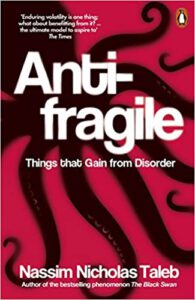
- Taleb, Nassim Nicholas: Antifragile: Things that Gain from Disorder.
- Taleb, Nassim Nicholas: The Black Swan: The Impact of the Highly Improbable: The Impact of the Highly Improbable
- Appelo, Jurgen: How to Change the World. Change Management 3.0.
- Snowden, Dave: Cynefin – Weaving Sense-Making Into the Fabric of Our World.