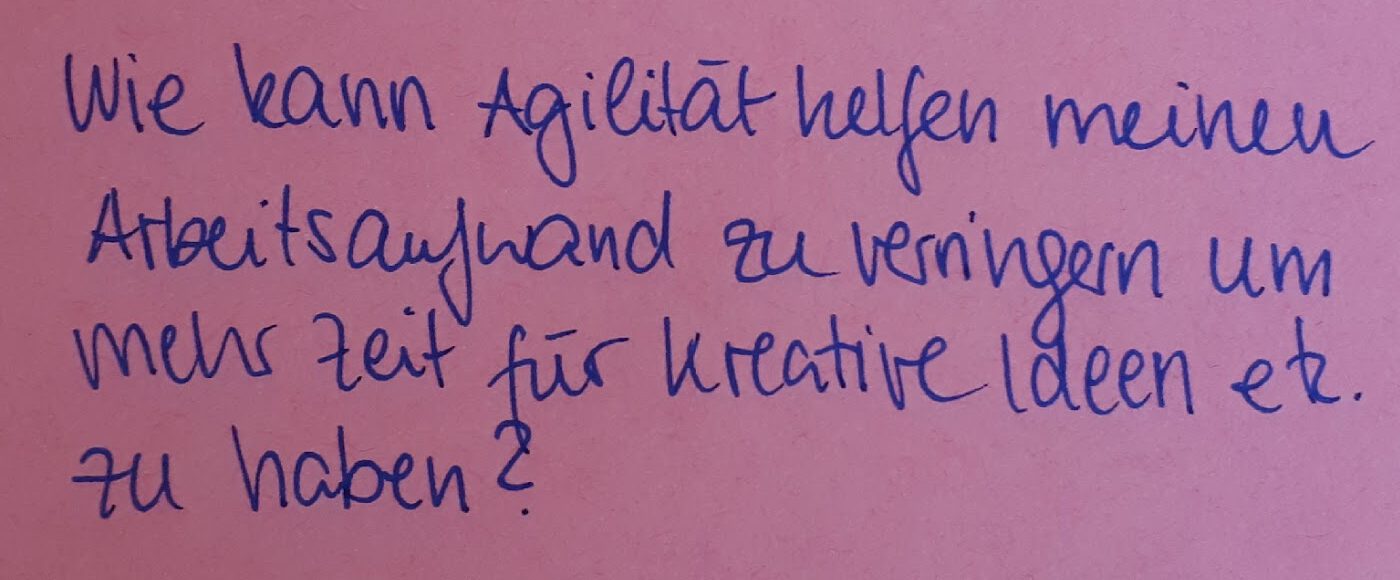
Wie kann Agilität helfen, meinen Arbeitsaufwand zu verringern, um mehr Zeit für kreative Ideen zu haben?
Im agilen Tun sind wir in jeder Minute (!) gefordert, uns zu fragen, was wirklich wichtig ist. Und zwar hinsichtlich unserer längerfristigen Ziele und: JETZT. Also im aktuellen Moment. Und das tun wir dann. Heißt natürlich auch:
Alles, was nicht wichtig ist, lassen wir sein.
Unter „wichtig“ kann man natürlich vieles verstehen. Und verschiedene Menschen haben dazu unterschiedliche Ansichten und auch Interessen. (KundInnen sind z.B. Menschen oder MitarbeiterInnen, sogar ManagerInnen). Dennoch: Agile ist sehr stark von den Ideen des Lean-Managements geprägt. Deshalb heißt die agile Antwort meist:
Wichtig ist alles, was der (längerfristigigen) Wertschöpfung dienlich ist.
Wertschöpfung findet nicht nur, aber vor allem dann statt, wenn Kunden für ein Produkt oder eine Lösung Geld ausgeben. Heißt: Diejenigen, die über die Wertschöpfung maßgeblich befinden, sind die Kunden bzw. die Nutzer. Erst DANACH kommen sonstige Stakeholder. (Auch wenn es oft und leider andersherum gelebt wird.)
Wenn Sie dafür eingestellt sind, kreative Ideen zu entwickeln, dann deshalb, weil man sich dadurch erhofft, dass Sie dadurch Wertschöpfung generieren. Um es überdeutlich zu sagen: Damit Sie genau damit GELD EINSPIELEN. Haben Sie nicht die Voraussetzungen dafür, kreative Ideen zu produzieren, so ist dieses wichtige Geschäftsziel in Gefahr. Und zwar ohne Not. Denn Voraussetzungen lassen sich ja schaffen.
Das ist also widersinnig. Das ändert auch nicht die Tatsache, dass solche Situationen in vielen vielen vielen Organisationen Realität ist.
Wichtig im Sinne von Lean bzw. Agile ist also, dass Ihr Arbeitsumfeld entsprechend geschaffen ist. Frei von allem, was Sie an Ihrer Arbeit hindert: Sie brauchen Freiraum, um kreativ werden zu können.
„Müssen“ mag ich ja eigentlich gar nicht. In diesem Fall müssen Sie sich aber tatsächlich mit Ihrem Team entsprechende Strukturen geben. Team heißt: Mit den Führungskräften und dem Management. Sonst können Sie Ihren Job nicht zur vollsten Zufriedenheit machen. Weder zur eigenen, noch Ihrer Firma Unternehmung, noch – das ist das wichtigste – zur vollsten Zufriedenheit Ihrer Kunden!
Strukturen geben kann vieles heißen. Quasi alle agilen Arbeitsrahmen verzichten z.B. konsequent auf alle überflüssigen Meetings (also solchen Treffen z.B., die Zeit verschwenden).
Wechsel- und Verzugskosten Erfolgsverhinderer Nummer 1
Wechselkosten sind z.B. der Weg von einem Meeting ins nächste oder die Zeit, die Sie brauchen, sich von einem Thema wieder ins nächste einzuarbeiten. Wechseln ist ein Luxus, den wir uns immer weniger werden leisten können. Denn andere, nicht-wechselnde Wettbewerber sind schlicht schneller und um ein Vielfaches (!) rentabler.
Im Agilen versuchen wir Wechselkosten zu minimieren, indem wir Störungen nach Möglichkeit vermeiden und von allem, was anstehet, nur die wichtigen Dinge tun.
Erfolg haben Sie nur mithilfe Ihrer Führungskräfte und im Zusammenspiel mit Ihrem Team!
Um Projekte und Aufgaben zu priorisieren, braucht es das vertrauensvolle Zusammenspiel der Business- und Expertenseite. Also von Experten wie Ihnen und Ihren ChefInnen.
Weil wir diese Art von Zusammenarbeit selten bis nie in Schule oder sonstwo kennenlernen oder üben, können wir das noch nicht. Und es ist ein schwieriger Lernprozess. Der zudem natürlich auch noch die gemeinsame (also nicht nur Ihre) Einsicht erfordert, dass dies momentan sogar ziemlich existentiell wichtig und der richtige, vermutlich sogar der einzige Weg für nachhaltigen (Zukufts-) Erfolg.
Und dann braucht es viel Nachhalten und gemeinsamen Willen.
Kurz zusammengefasst
Im „agilen Maschinenraum“ befindet sich ein ausgeprägtes Lean-Mindset. Und das versucht, alles Überflüssige, alles, was die Wertschöpfung in den Prozessen be- oder sogar verhindert, kontinuierlich aus dem System zu bekommen und es dort auch zu halten. In Ihrem Falle also alles, was Sie daran hindert, Ihren Job zu tun und den größten Ihrer Zeit kreative Ideen zu entwickeln.
Damit uns das gelingt, brauchen wir unbedingt das gemeinsame Verständnis, dass es (im Sinne der Wertschöpfung) wichtig ist, Verschwendung dieser Art zu verhindern.
Auch, dass dies nicht einer Person alleine gelingen kann (z.B. Ihnen persönlich), sondern dass wir das nur gemeinsam schaffen. Also im Team inklusive Führungskräften und – radikal! – eventuell mit KollegInnen angrenzender Abteilungen oder – noch radikaler! – gemeinsam mit Kunden und/oder sogar mit Zulieferern!
Und dann ist zu lernen, in gemeinsamem Feedbackschleifen genau das zu tun, also – nach und nach – den überflüssigen Aufwand zu reduzieren und Raum für kreatives Arbeiten zu erschließen.
Die agilen Routinen sind genau dafür gedacht. Um Punkte wie den von Ihnen genannten, anzubringen und – gemeinsam mit dem Team, also auch der Führungskraft – nach Lösungsmöglichkeiten zu suchen. (In Ihrem Falle wäre übrigens in Scrum die Sprint-Retrospective der Ort, Ihr „kreatives“ Problem im Team anzubringen.)
 Weiterlesen
-
- Anderson, David J.: Die Essenz von Kanban – kompakt.
- Appelo, Jurgen: Managing for Happiness. Übungen, Werkzeuge und Praktiken, um jedes Team zu motivieren.
- Purps-Pardigol, Sebastian: Führen mit Hirn. Mitarbeiter begeistern und Unternehmenserfolg steigern.
- Sutherland, Jeff: Die Scrum-Revolution.
- Schwaber, Ken; Sutherland, Jeff: Scrum Guide (kostenlos)
How can Agile help reduce my workload to allow more time for creative work?
In Agile working, every minute (!) we are challenged to ask ourselves what really is important to do. In terms of our longer-term goals and: NOW. In the present moment. That’s exactly what we’ll do. Meaning, of course, that we drop everything unimportant.
„Important“ can mean many things. Different people have different views and interests on this. But because Agile is very much influenced by the ideas of lean management, the Agile answer is usually:
What is important is what serves to create ( long-term) value.
Value is created primarily when customers pay money for a product or solution. This means that it is the customers or users who decide on value creation. Only THEN other stakeholders are been taken into account. (Even if, unfortunately, it is often practised the other way round.)
If you’ve been hired to produce creative ideas, it’s because that’s exactly what you’re supposed to do to generate value (=bring in money). If you don’t deliver ideas or don’t have the prerequisites that you can deliver, this (business) goal is in danger. And this: Without any need.
So this is absurd. The fact that such situations are a reality in many many many organisations does not change this.
What is important in the sense of Lean or Agile – that is, in the sense of real value creation, i.e. in order to earn money – is that you have a suitable working environment. Free from everything that hinders you. You need creative space.
I really don’t like „Have to“. In this case, however, it is absolutely necessary that you set up appropriate structures in and with your team – that means also with the leader and the management. Otherwise, you will not be able to do your job to your fullest satisfaction. Neither to your own, nor your company’s, nor – most importantly – your customers‘ satisfaction!
Giving yourself appropriate structures can mean many things. Virtually all agile working frameworks, for example, consistently do without meetings that are not absolutely necessary (read: meetings that cost unnecessary (!) time).
Costs of Switching and delay are the number 1 obstacle to success.
Switching costs are, for example, the way from one meeting to the next or the time it takes you to think your way back from one topic to the next. Switching is a luxury we will be able to afford less and less. Because other, non-switching competitors are simply faster and more profitable.