Wer sich dem Thema Agilität nähert, hat meist viele Fragen. Das ist total normal. Ich bin zum Beispiel neulich gefragt worden, ob in Projekten Mischformen aus agil und klassisch arbeiten möglich sind. Genauer lautete die Frage:
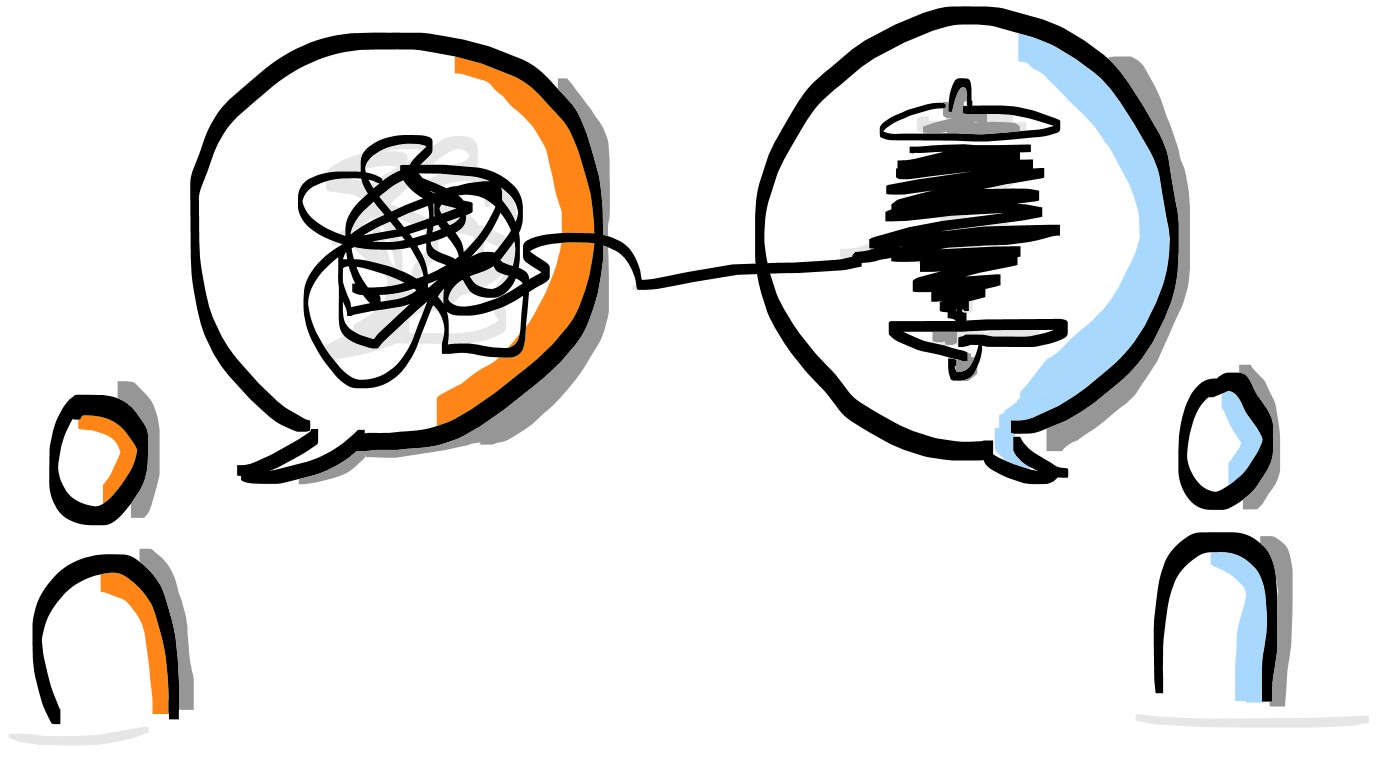
Manche Projekte brauchen einen festen Budget- und Zeitrahmen – gibt es hier Möglichkeiten einer Mischform aus agil und klassisch?
Diese Frage ist leicht beantwortet: Natürlich sind Mischformen aus agil und klassisch möglich.
Wer sich aufmacht, agil zu arbeiten, kommt meist gar nicht umhin, die Methoden zu mischen. Alleine schon, weil Menschen dazu neigen, in alte Muster zu verfallen. Aber auch, weil ganze Organisationen nicht auf Knopfdruck agil umgestellt werden können.
Und das gilt, auch wenn
(eigentlich aber GERADE WEIL) wir wissen, dass genau DAS im regelmäßig widerkehrenden Umstrukturierungswahnsinn unser aller Firmen immer wieder mit der Brechstange versucht wird zu tun. Mit immer wieder mäßigem bis ausbleibenden Erfolg. Ja, übrigens oft auch, wenn per agilem Marschbefehl die Arbeitsweise auf Agil umgestellt werden soll.
Das ist natürlich schrecklich. (Auch meist schrecklich erfolglos.) Und – nicht nur nebenbei bemerkt – völlig unagil.
 Doch zur Frage zurück.
 Doch zur Frage zurück.
Teams suchen sich als Spezialisten ihrer eigenen Arbeit immer jene Formen der Zusammenarbeit, die gut für sie und ihr Geschäft sind.
Heißt: Es ist möglich, dass sich Teams dann eben hier und dort bedienen.
Doch selbst wenn sich Versatzstücke aus der jeweils anderen Welt finden, so ist doch eher wahrscheinlich, dass sich die Teams mittelfristig für die eine oder die andere Form entscheiden.
Das gilt übrigens unabhängig davon, ob ein fester Rahmen existiert oder nicht.
In diesem Zusammenhang
 In diesem Zusammenhang
 möchte ich daran erinnern, dass agile Arbeitsrahmen deshalb erfunden wurden, weil die bisherigen Mittel eben immer öfter nicht verhindern konnten und können, dass feste Rahmen gesprengt werden.
Anders formuliert: Klassisches Management ist kein Garant dafür, dass feste Budget- und Zeitrahmen eingehalten werden.
DIESE Lektion sollten wir ja nun wirklich gelernt haben. Gerade in Deutschland, nach Berlin, Hamburg, Stuttgart und diverse Verkehrsprojekte des Bundes – um nur die teuerste Spitze des Eisbergs zu nennen. Ihnen fallen sicherlich noch einige eigene Beispiele für aus dem Ruder gelaufene Firmen-Projekte ein.
Dass das klassische Management-Ansätze nicht dafür garantieren kann,
dass der zeitliche und finanzielle Planungsrahmen eingehalten wird, liegt aber gar nicht am klassischen Management selbst. Viel mehr ist es so, dass das überhaupt keine Herangehensweise garantieren kann.
Auch Agilität nicht. Sie geht mit dieser Tatsache aber offen und auf eine besonders wirksame Art und Weise um.
Wie sich Projekte entwickeln, lässt sich zwar im Vorfeld mehr oder weniger gut abschätzen
und meinetwegen auch planen. Trotzdem kann Unvorhergesehenes passieren. Und das tut es ja auch regelmäßig.
Ganz unabhängig davon, auf welche Art Projekte gemanagt werden.
Egal, wie gut sie geplant waren.
Und egal, wie gut sie überwacht wurden.
Sicherheit wird es also nicht zu hundert Prozent geben
auch wenn sich das AuftraggeberInnen, InhaberInnen, Management und Team gleichermaßen wünschen.
Agile Herangehensweise und Methoden wie z.B. Scrum und Kanban erkennen das offen an. (Also beides: dass es keine völlige Sicherheit geben kann UND dass wir sie uns aber alle wünschen).
Gewissermaßen als zweitbeste Lösung streben sie deshalb eine möglichst große gegenseitige Verlässlichkeit an. Gleichzeitig minimieren sie die Projektrisiken durch methodische Prinzipien wie: Expertenwissen im gesamten Team nutzen, Betroffene zu Beteiligten machen, kurze Experimentier-, Feedback- und Lernschleifen etc.

Die Erfahrung zeigt dass dies sehr gut funktioniert.
Die Geschwindigkeit und Zielgenauigkeit verbessert sich in der Regel sehr schnell. Auch und gerade bei festen Vorgaben für Projekt- oder Geschäftsziele.
Übrigens: Diese festen Vorgaben für Projekt- und Geschäftsziele bestehen übrigens nicht nur für manche, sondern IMMER für ALLE Geschäftstätigkeiten und Projekte.
Doch darüber mal ein andermal…
Whoever starts learning about Agile usually has a lot of questions. Totally normal. I was, for example, recently asked whether mixed forms of Agile and Traditional project work are possible. More precisely, the question was:
Some projects need to be rolled out within fixed budget and time frames – is it possible to work with a mixed form of Agile and Traditional here?
First of all, it should be said that mixing Agile and Traditional is a possibility, of course.
Whoever sets out to work Agile, usually cannot avoid mixing the methods anyway. If only because people tend to fall into old patterns. But also because entire organizations can not be converted to agile by pressing a button.
And this is true even if (but actually JUST BECAUSE) we know that exactly THAT is what we try to achieve with again and again enrolling restructuring measures within the companies of ours.
Again and again with moderate to no success.
By the way, this is also often the case when „Agile marching orders“ are given in order to change the way of working into any kind of „Agile culture“.
This of course is terrible. (Also usually terribly unsuccessful.) And – let me mention this very clearly – completely unagile.
But back to the question.
As specialists of their own work, teams always choose those forms of collaboration that are good for them and their business
This means: It is possible that teams simply use agile and traditional approaches.
But even if ýou’ll find ways of doing from different worlds, it is more likely that teams will opt for one form or the other in the medium run.
By the way, this is true whether there is fixed framework of time and budget.
In this context
I would like to remind you that Agile working frameworks were invented because more and more often „traditional“ means could and can not prevent that teams fail to meet the requirements of time and budget.
Or to put it another way: Classical management is no guarantee that project goals are being met.
THIS is a lesson we really should have learned by now.Especially in Germany, after Berlin, Hamburg and Stuttgart – to name just the most expensive tip of the iceberg. You surely can think of some more examples of your own company projects that got out of hand.
But it is not (only) the fault of classical management approaches that this happens.
Rather, NO approach whatsoever can guarantee that the goals will be reached.
Neither can Agile. But it handles this fact openly and in a particularly effective way.
How projects develop can be estimated in advance.
And project can be planned for. Nevertheless, the unexpected can happen. And it does so on a regular basis.
Regardless of how projects are managed.
No matter how well they were planned.
And no matter how well they were monitored.
So there will not be one hundred percent security
even if clients, owners, management and team alike would like to see that happen.
Agile approaches and methods
such as Scrum and Kanban openly acknowledge this. (Meaning acknowledging both: that there can’t be complete security AND that we all urge for it.)
So, in a sense, as a second-best solution, they strive to maximize mutual reliability. At the same time, they minimize project risks through methodological principles such as: Using expert knowledge across the team, turning those affected into participants, short experimentation, feedback and learning loops, etc.
Experience shows that this works very well.
The speed and accuracy of goal getting usually improves very quickly. Also and especially with fixed requirements for project or business goals.
By the way, these fixed requirements for project and business goals exist not only for some, but ALWAYS for ALL business activities and projects.
About that, however, some other time…