Sie haben den agilen Marschbefehl bekommen? Sie wollen selbst in den Kampf ziehen? Bevor es losgeht, haben Sie aber noch ein bisschen Klärungsbedarf? Sie sind nicht allein. Ich bin zum Beispiel kürzlich gefragt worden:
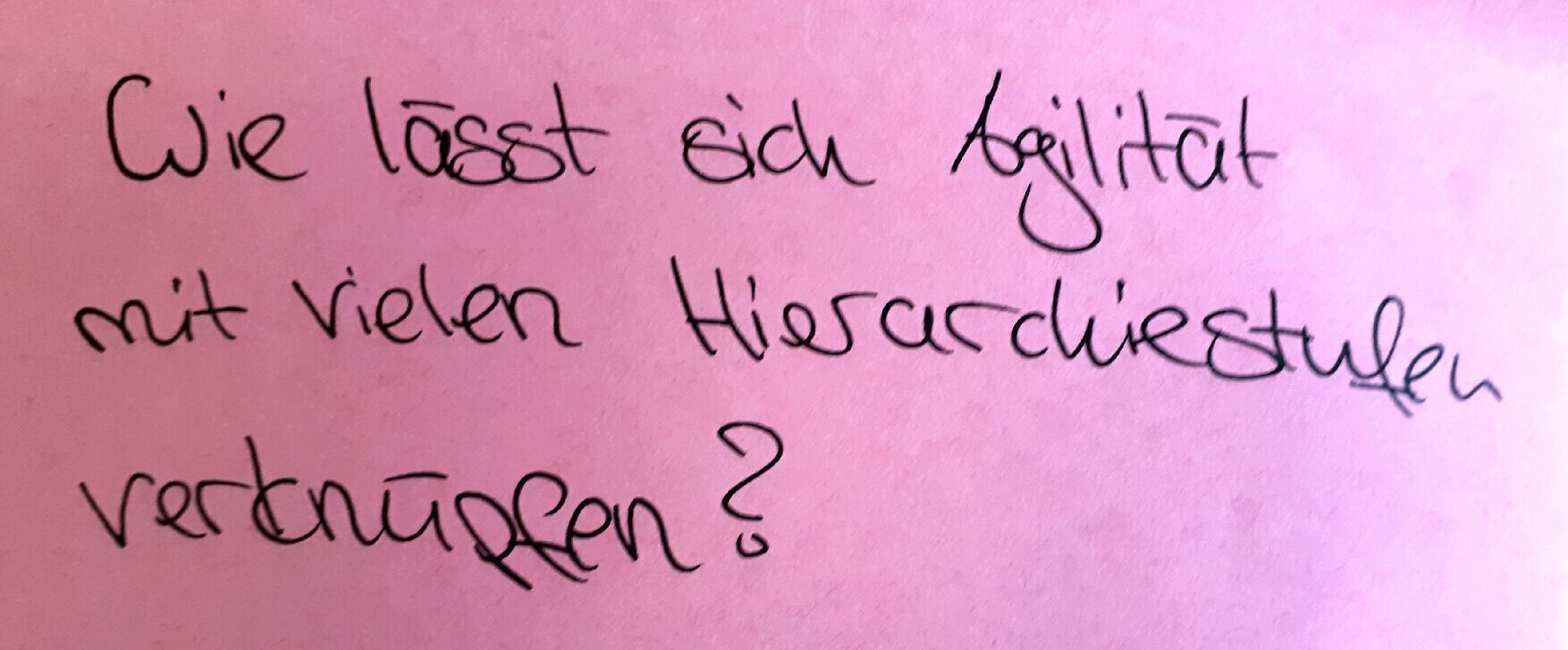
Wie lässt sich Agilität mit vielen Hierarchiestufen verbinden?
Das ist einfach zu beantworten: Schwer. Bis gar nicht.
Warum?
Im agilen Betriebsraum befindet sich Lean. Die Devise heißt also: „Verschwendung (‚Waste‘) vermeiden!“. Gemeint ist alles, was die Wertschöpfung behindert.
Hierarchien gehören meist in diese Kategorie, weil sie – ohne Grund oder Not – den Prozess verteuern und verlangsamen. Beides steht übrigens vor allem bei Kunden und Anlegern nicht besonders hoch im Kurs.
Aber Achtung!
Wer jetzt denkt, Agilität arbeit hierachiefrei, der irrt! Agilität arbeitet sehr wohl und bewusst mit Hierarchien. Nur eben anders als im klassischen Management. Nämlich NICHT mit STATUS-Hierarchien, sondern mit ENTSCHEIDUNGShierarchien. Ansonsten gilt: Augenhöhe.
Agiler Grundkonsens ist: ALLE sind für das bestmögliche Ergebnis verantwortlich. Für einen reibungslosen Ablauf und für den Fall, dass sich das Team in manchen Fällen schwer tut zu entscheiden, und NUR DANN, ist klar wer welche Entscheidung treffen darf.
Für die Rollen in Scrum, ihre Verantwortlichkeiten und Aufgaben wird das z.B. so geregelt:
- Der Product Owner entscheidet im Gespräch mit den Stakeholdern und dem Umsetzungsteam, WAS gemacht werden soll.
- Die Experten wiederum, also das Umsetzungsteam, entscheiden darüber, WIE sie es angehen.
- Management und Stakeholder dagegen entscheiden darüber, wie die übergeordnete Strategie aussieht, was die Unternehmens- oder Produkt-Vision ist und ob und wie all das finanziert wird (Rahmen setzen). Wer zahlt, schafft schließlich an, soll heißen: Wer zahlt, entscheidet über diese Dinge.
Über mehr dann aber auch wieder nicht.
Weiterlesen?
- Balle, Michael u.a.: The Lean Strategy: Using Lean to Create Competitive Advantage, Unleash Innovation, and Deliver Sustainable Growth.
- Emiliani, Bob: The Triumph of Classical Management Over Lean Management. How Tradition Prevails and what to Do about it.
- Laloux, Frederic: Reinventing Organizations.
- Robertson, Brian J.: Holacracy. The Revolutionary Management System that Abolishes Hierarchy.
- Rother, Mike: Die Kata des Weltmarktführers. Toyotas Erfolgsmethoden.
- Sutherland, Jeff: Scrum. The Art of Doing Twice the Work in Half the Time. (Deutsch: Die Scrum-Revolution)
- Verhaeghe, Paul: Autorität und Verantwortung.
You have been given the Agile marching orders? Do you want to go into battle yourself? But before you get started, you still need a bit of clarification? You are not alone. I, for example, have recently been asked:
How Does Agile Work With Many Levels of Hierarchy?
That’s an easy one to answer: Difficult. To not at all.
Why?
The Agile source code is Lean. So the motto is: „Avoid waste!“. This means everything that hinders the creation of value.
Hierarchies usually belong in this waste category because they – without reason or need – make the process more expensive and slow. Incidentally, neither of these is particularly popular with clients and investors.
But listen up!
Anyone who thinks that Agile works without hierarchies is mistaken! An agile approach does work with hierarchies and does so consciously. Just differently than in classical management. That is, NOT with hierarchies of STATUS, but with hierarchies of DECISION. Apart from that, the rule is: Eye-level.
The fundamental agile consensus is that EVERYONE is responsible for the best possible result. For a smooth process and in the event that the team has a hard time deciding in some cases, and ONLY THEN, it is clear who is allowed to make which decision.
For the roles in Scrum, their responsibilities and tasks are regulated e.g. like this:
- The product owner decides WHAT is to be done in discussion with the stakeholders and the development team.
- The experts in turn, i.e. the development team, decide HOW to go about it.
- Management and stakeholders, on the other hand, decide what the overarching strategy is, what the corporate or product vision is and whether and how all this is financed (setting the framework). After all, he who pays decides on these things.
But then again, not about much more.
Wanna Read More?
- Balle, Michael u.a.: The Lean Strategy: Using Lean to Create Competitive Advantage, Unleash Innovation, and Deliver Sustainable Growth.
- Emiliani, Bob: The Triumph of Classical Management Over Lean Management. How Tradition Prevails and what to Do about it.
- Laloux, Frederic: Reinventing Organizations.
- Robertson, Brian J.: Holacracy. The Revolutionary Management System that Abolishes Hierarchy.
- Rother, Mike: Die Kata des Weltmarktführers. Toyotas Erfolgsmethoden.
- Sutherland, Jeff: Scrum. The Art of Doing Twice the Work in Half the Time. (Deutsch: Die Scrum-Revolution)
- Verhaeghe, Paul: Autorität und Verantwortung.