Man hat Ihnen gesagt, Sie sollen agiler arbeiten? Oder Sie sind selbst darauf gekommen, dass das eine gute Idee sein könnte? Jetzt aber fragen Sie sich, ob das wirklich eine so gute Idee ist und woran Sie das merken? Sie sind nicht allein. Ich bin zum Beispiel kürzlich gefragt worden:
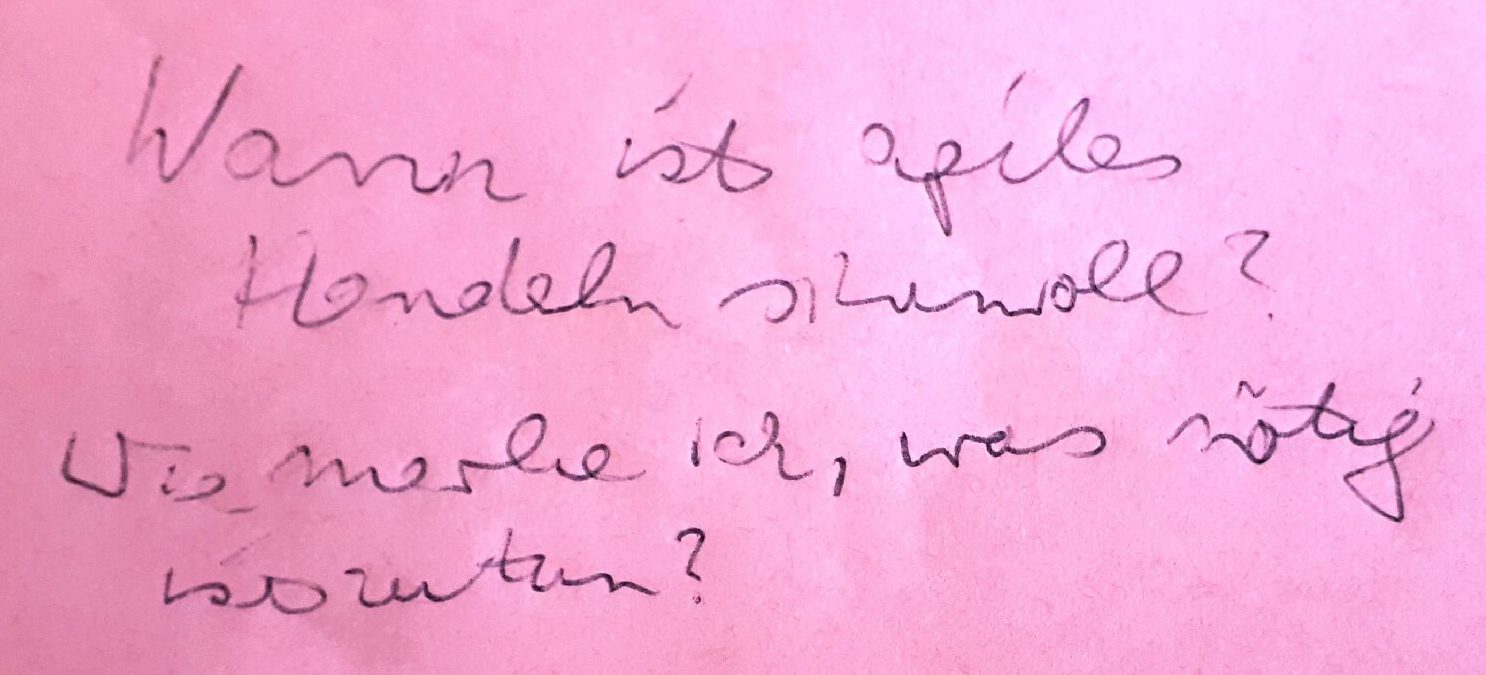
Wann ist agiles Handeln sinnvoll? Wie merke ich, was möglich ist zu tun?
Wichtigstes und prägnantestes Element agiler Zusammenarbeit sind Feedbackschleifen, in welchen sich möglichst alle Beteiligten zu den wichtigsten inhaltlichen und strukturellen Punkten Rückmeldungen austauschen. Das hat einen Grund.
Denn: In welchen Situationen ist es besonders notwendig, sich häufig rückzuversichern und zu überprüfen, ob noch alles in Ordnung ist, man noch auf dem richtigen Weg ist, sich abzustimmen und gegebenfalls Änderungen vorzunehmen? Wenn es besonders unübersichtlich und unsicher ist. Deshalb lautet die
 Faustregel
 Faustregel
Je unsicherer, unübersichtlicher und komplexer das Umfeld, desto agiler. Denn agil bedeutet: Desto kürzer die Abstände, in welchen wir uns treffen, um die wichtigen Dingen zu besprechen und uns fragen, ob wir noch auf der richtigen Fährte sind.
Doch Warnung: Alleine wird das nix! Das geht nur zusammen. Agilität ist ein Teamsport.
Und noch ein Hinweis: Das gilt selbst auch in Bereichen, wo es vermeintlich planbar zu geht. Also überall dort, wo es viele gleichförmige und wiederkehrende Arbeiten zu erledigen gibt. So stelle ich mir z.B. Buchhaltung oder die Arbeit in Anwaltskanzleien vor. Auch hier – vielleicht sogar gerade hier – sollte sich das Team regelmäßig die Frage stellen, was organisatorisch und qualitativ bedacht oder angepasst werden sollte, damit die Arbeit der nächsten Zeit möglichst gut und zur Zufriedenheit der internen und externen Kunden erledigen zu können. Ansonsten übersieht man vielleicht gerade einen wichtigen Punkt. Im schlimmsten Fall sogar einen wichtigen Trend.
Also auch in vermeintlich sehr sicheren Umfeldern macht es Sinn, die Frage zu stellen, ob noch alles in Ordnung ist.
Weiterlesen?
- Snowden, David J.; Boone, Mary E.: A Leader’s Framework for Decision Making. Harvard Business Review, November 2017.
- Shenhar, Aaron J.; Dvir, Dov: Reinventing Project Management.
- Taleb, Nassim Nicholas: Antifragilität
You’ve been told to work in a more Agile way? Or you figured it out for yourself that it might be a good idea? But now you’re wondering if it’s really such a good idea and how you can tell? You are not alone. I, for instance, recently have been asked:
When Is Agile Working Useful? How Can I Tell?
The most important and succinct element of agile collaboration is feedback loops, in which, if possible, all participants exchange feedback on the most important points. There is a reason for this.
Because: In which situations is it particularly necessary to frequently check back and see if everything is still OK, if you are still on the right track, to coordinate and, if necessary, to make changes? When things are confusing and uncertain. That’s precisely the reason for the
Rule of Thumb
The more uncertain, confusing and complex the environment, the more Agile you should act. Because Agile means: the shorter the intervals at which we meet to discuss the important things and ask ourselves whether we are still on the right track
Mind you, though: You can’t do it on your own! It can only be done together. Agile is a team sport.
And another note: This also applies in areas where things are supposedly predictable. In other words, everywhere where there is a lot of uniforms and recurring work to be done. This is how I imagine accounting or work in law firms, for example. Here, too – maybe even here in particular – the team should regularly ask itself what needs to be considered or adapted organisationally and qualitatively in order to get the work done as well as possible and to the satisfaction of internal and external clients. Otherwise, you might just overlook an important point. In the worst case, even an important trend.
So even in supposedly very secure environments, it makes sense to keep asking the question whether everything is still in order
Weiterlesen?
- Snowden, David J.; Boone, Mary E.: A Leader’s Framework for Decision Making. Harvard Business Review, November 2017.
- Shenhar, Aaron J.; Dvir, Dov: Reinventing Project Management.
- Taleb, Nassim Nicholas: Antifragilität