Viele Führungskräfte und MitarbeiterInnen fragen sich, was Management in einer agilen Umgebung bedeutet. Was ist an agilem Management anders als bisher? Brauchen wir explizit agiles Management? Und falls ja, was bedeutet das?
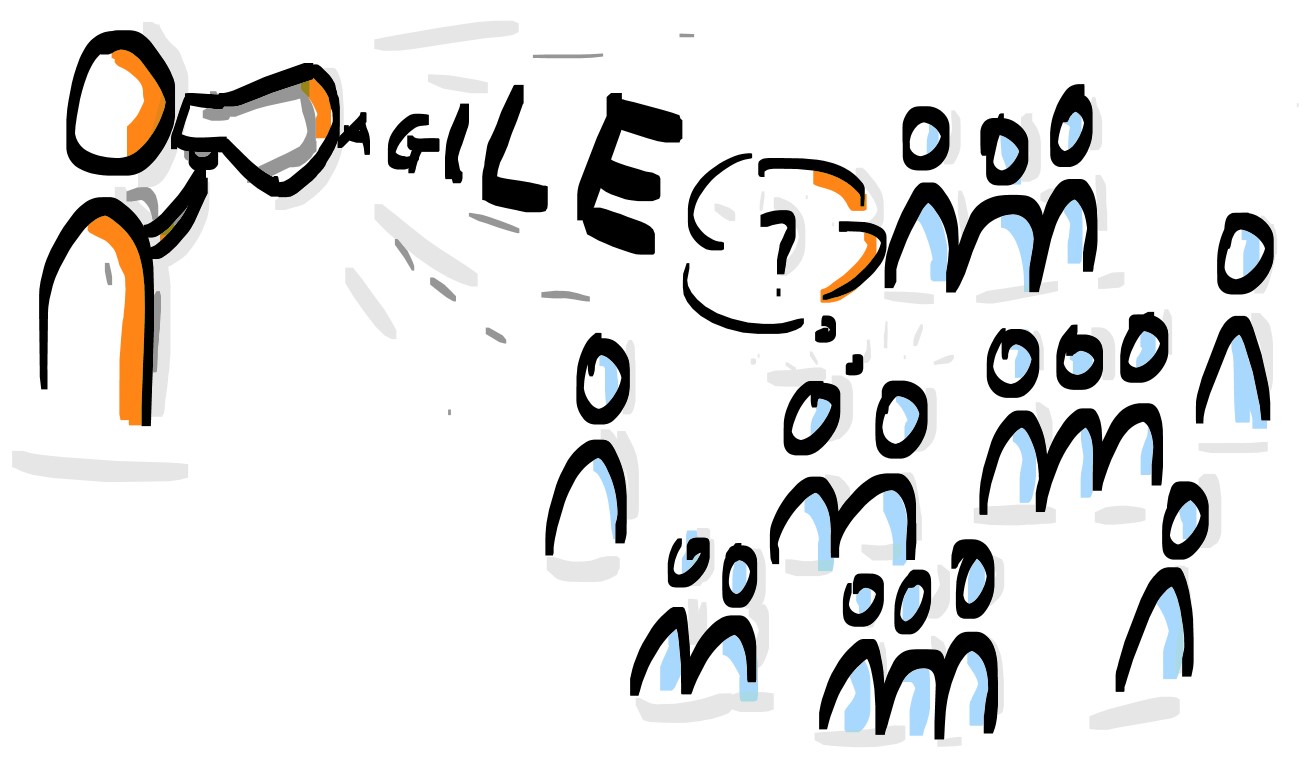
Überall, wo nun Agilität verordnet ist
ergeben sich für viele Führungskräfte und Mitarbeitende die ganz praktische Alltagsfrage: Was um alles in der Welt heißt das nur konkret für mich als ManagerIn, ProjektmanagerIn oder Teamitglied, was für das Management oder die allgemeine Organisation?
Natürlich gilt: Management ist und bleibt Management. Und ja, ob es wirksam oder unwirksam ist, ist von Kontext und individuellem Wirken der Beteiligten abhängig.
Wie bei einer Wurzelbehandlung verortet sich allerdings auch genau hier der große Alltagsschmerz, den all jene verspüren, die nun agil arbeiten und gute, am besten exzellente Ergebnisse produzieren sollen. Leider aber finden sie selten die Voraussetzungen dafür vor, die es braucht, damit Agilität überhaupt positiv wirken kann.
Agile Ansätze haben sich entwickelt
weil sie im Vergleich zu den bis dato angewendeten Organisationsformen in bestimmten Bereichen wettbewerbsfähigere Antworten versprachen. Veränderungen solcher Art bringen immer einen Wandel der Prioritäten, der Perspektiven, der Herangehensweisen und auch: der Weltsichten mit sich.
Und damit auch viele Reibereien.
So ist das auch bei der Agilität. Sie bietet allerdings besonders viel Stoff für Konflikte. Denn ihre Grundüberzeugungen sind überaus konträr zu bisherigen Managementphilosophien. Und auch ihr struktureller Aufbau ist radikal anders als alles bisher Praktizierte.
Deshalb verläuft ein agiler Change für involvierte Einzelpersonen und gesamte Organisation meist besonders konfliktträchtig. Es geht ans Eingemachte, um Überzeugungen und Werte, um den richtigen Weg, die ganz großen Themen also: Führen, Motivation, Vertrauen, Gruppen- statt Einzelleistung, Status etc.

Dem agilen Gedanken
liegt letztlich ein vollkommen anderes Verständnis von Menschen, Organisationen, deren Motivationen und Wirkweisen zugrunde, nämlich ein im reinsten Sinne konstruktivistisch-systemtheoretisches – genau das macht den agilen Vorteil aus. Mit den Worten meines lieben Kollegen und Mentors, Jan Fischbach, gesprochen:
„Menschen und menschliche Organisationen sind komplexe adaptive Systeme.“
Und eben keine einfachen Input-X-Output-Y-Automaten. Doch auf eben dieser Kausalitäts-Denkweise bauen heute noch die Strukturen in den meisten Firmen auf. Dies oft wider besseren Wissens. And auch, OBWOHL dort vielleicht schon laut Firmenpropaganda agil gearbeitet wird).
Den Rahmen für Zusammenarbeit
zu stecken ist DIE klassische und oberste Management- und vor allem auch Führungsaufgabe. Im agilen Change ist sie sogar besonders wichtig, eben weil es um einen fast schon maximal großen (Werte-) Wandel geht, mit dem unweigerlich sehr viele starke (Verlust-) Ängste und Widerstände verbunden sind.
Insofern ist für mich die Eingangsfrage eindeutig zu beantworten: Agiles Management unterscheidet sich stark vom bisherigen Management. Zum Beispiel weil
- es davon überzeugt ist, dass es ausschließlich intrinsische Motivation gibt;
- weil es radikal auf weitgehend selbstorganisierte Gruppenprozesse vertraut und sie deshalb uneingeschränkt auf (strukturierten) Gruppenentscheidungen aufbaut;
- weil es ausschließlich in Aufgaben und Rollen denkt und deshalb komplett auf Hierarchie, Status und infolgedessen auf Zwang jeglicher Art verzichtet – nicht nur in der allgemeinen organisatorischen Struktur, sondern vor allem in der individuellen Kommunikation und im Handeln!
 All das macht deutlich
 All das macht deutlich
Zwar bleiben Manager Manager. Aber es braucht spezialisierte agile Manager! Denn Agilität hat eine bestimmte Ausrichtung mit einem bestimmten Auftrag, woraus sich für alle andere Aufgaben als in einem nicht-agilen Umfeld ergeben.
Deshalb brauchen agile Manager andere Fähigkeiten und Mittel und auch andere Strukturen als ihre Kolleginnen und Kollegen in nicht-agilen Organisationen. Vor allem aber brauchen agile Manager eine SYSTEMISCHE Prozessdenke, agile Überzeugungen und eine entsprechende persönliche Haltung.
Und den ÜBERZEUGTEN Willen des Top-Level Managements, agil zu arbeiten. Mit allem, was dazugehört.
Many managers and employees wonder what management means within an Agile working environment. What is the difference when it comes to Agile management? Do we explicitly need Agile management? And if so, what does it mean?
Wherever Agile is imposed these days
the very practical day-to-day question arises for many managers and employees: what on earth does this mean in concrete terms for me as a manager, project manager, or team member, and what for management or the organization as a whole?
Of course, management is and remains management. And yes, whether it is effective or ineffective still depends on the context and the individual actions of those involved.
As with a root canal, however, this is exactly where the great everyday pain is felt by all those who now work in an agile manner. All those people who are supposed to produce good, preferably excellent results with Agile. Unfortunately, however, they rarely find the conditions that are needed for Agility to have any positive effect at all.
Agile approaches have evolved
because they promised a more competitive response in certain areas compared to the organizational forms used to date. Changes of this kind always imply a change in priorities, perspectives, approaches, and also: world views.
And with it, a lot of friction.
This also applies to Agility. However, it offers a particularly large amount of material for conflicts. This is because its basic convictions are EXTREMELY contrary to previous management philosophies. And its structural design is also radically different from anything practiced to date.
This is why an Agile change is usually particularly prone to conflict for the individuals involved and the entire organization. It gets down to the nitty-gritty, about convictions and values, about the right path, the really big issues, in other words: leadership, motivation, trust, group performance rather than individual performance, status, etc.
.
The Agile idea
is based ultimately on a completely different understanding of people, organizations, their motivations, and modes of action, namely a constructivist-systems theory in the purest sense – which is precisely what makes the Agile advantage. In the words of my dear colleague and mentor, Jan Fischbach:
„People and human organizations are complex adaptive systems.“
And precisely not simple input-X-output-Y automatons. But on just this causality way of thinking still builds the structures in most companies today. This often against better knowledge. And also, although there may be Agile teams are in place, at least according to company propaganda.
Setting the framework for collaboration
is THE classic and top management and especially leadership task. In the Agile change, it is even particularly important, exactly because it concerns a nearly maximum (value) change, with which inevitably many powerful fears and resistances are attached.
Thus for me the answer to the initial question is clearly: Agile management is very different from existing management. For example, because
- it is convinced that there is only intrinsic motivation;
- because it radically trusts in mainly self-organized group processes and therefore and unrestrictedly is based on (structured) group decisions;
- because it thinks exclusively in terms of tasks and roles and therefore completely renounces hierarchy, status, and consequently coercion of any kind – not only in the general organizational structure but especially in individual communication and action!
All this makes clear
It is true that a manager remains a manager. But it needs specialized Agile managers! Because Agile has a specific focus with a specific mission, which results in different tasks for everyone than in a non-Agile environment.
Therefore, Agile managers need different skills and resources and also different structures than their colleagues in non-Agile organizations. Above all, Agile managers need a SYSTEMIC process mindset, Agile convictions, and a corresponding personal attitude.
And the will of top-level management to work in an AGILE way.