Sie sollen agil arbeiten? Sie überlegen selbst, ob es nicht sinnvoll wäre, ein bisschen etwas in diese Richtung auszuprobieren? Sie sind nicht allein. Ich bin z.B. kürzlich gefragt worden:
Was sind die wichtigsten Voraussetzungen für agiles Arbeiten?
 Zumindest, wenn sie schlau sind, fragen sich veränderungswillige Menschen immer, ob die Voraussetzungen für die Veränderung gegeben sind. Im Falle von Agile drängt sich diese Frage schlauen Menschen (also allen) vor allem deshalb besonders auf, weil Ihnen (natürlich) sofort auffällt: Agile heißt Selbstorganisation. Und DAS IST ETWAS GANZ GANZ ANDERES als die zwanghafte Command-And-Control-Kultur, in der wir hier momentan arbeiten!
Die wichtigste Voraussetzung für agiles Arbeiten
…ist für mich deshalb: Die Erkenntnis, dass es anders nicht mehr geht.
Wer diese Einsicht nicht hat, wird am Alten festhalten. Wir alle tun nun mal meist nur Dinge, die uns (persönlich) als sinnvoll erscheinen.
Um agileres Arbeiten im Team oder der gesamten Unternehmung anzustoßen, ist erfahrungsgemäß SEHR wichtig, allen Menschen WERTSCHÄTZEND die Möglichkeit zu geben, sich mit der Frage auseinanderzusetzen:
- was Agilität eigentlich ist
- warum überhaupt Agile
- warum Agile so vorgeht, wie es eben vorgeht und vor allem:
- was das für den eigenen Arbeitsalltag bedeuten und bringen kann.
Bemerkung am Rande: Um sich diese Fragen zu beantworten brauchen unterschiedliche Menschen unterschiedlich viel Zeit.
Das Führungsverhalten des Managements…
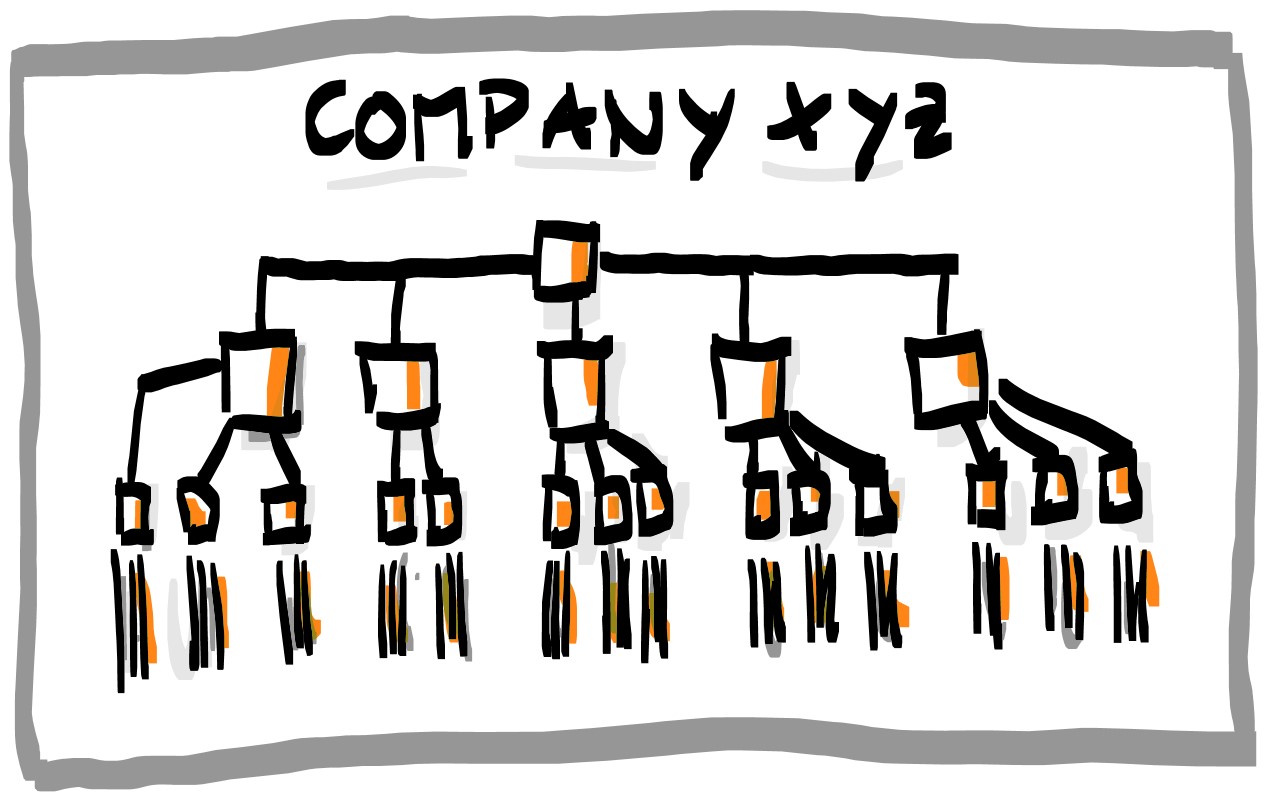
…ist hierbei einer der entscheidendsten Faktoren. Warum? Leben sie agiles Arbeiten nicht vor, verhalten sie sich also wie eh und je, ist das für alle anderen das zwar subtile, aber eindeutige Signal, dass alles beim Alten bleiben soll. So ticken wir Rudeltiere nun mal.
Deshalb wäre es sehr sinnvoll…
… dass sich zuerst und VOR ALLEN ANDEREN (!!!) der Führungskreis mit agilen Formen der Zusammenarbeit auseinandersetzt, statt den Change lediglich zu delegieren. Mindestens aber geschieht das zusammen und gleichzeitig mit allen anderen.
Denn Führungskräfte sollten natürlich zuerst verstanden haben, warum ein agiler Wandel nötig ist und was er bringen kann. Und auch: Was das in letzter Konsequenz bedeutet, nämlich:
- Arbeiten auf Augenhöhe,
- die gekippte Hierarchie-Pyramide,
- abgebaute Ko-Abhängigkeiten und damit weniger Manipulationsmöglichkeiten im Verborgenen,
- Abbau von hinderlichen und kostspieligen Macht und Status-Strukturen etc.
Und, ja: Führungskräfte sollten selbst dann im Vorfeld involviert werden, wenn das den agilen Wandel abblasen könnte, bevor er gestartet wird. Denn das ist die EINZIGE CHANCE, spätere nervige Guerilla-Kämpfe von Gegnern des agilen Changes möglichst im Rahmen zu halten. (Scharmützel werden trotzdem stattfinden, aber eben nicht so viele und mit nicht so vielen Opfern.)
Idealerweise…
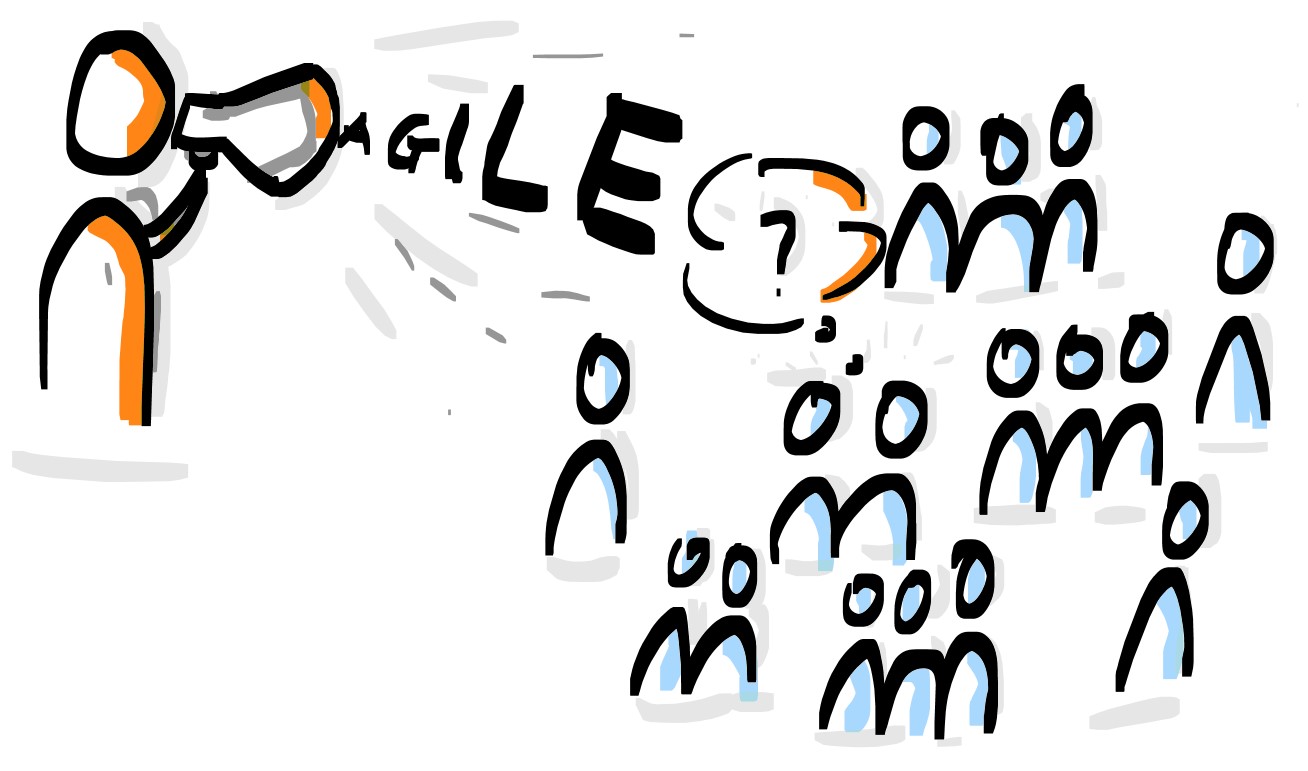
…wäre DAS der beste Weg. Der aber wird seltener gewählt als man meinen würde. Heißt: Natürlich wird oft erst einmal unverstanden der „agile Marschbefehl“ ausgegeben: „Ihr werdet agil, bei uns im Management ändert sich nichts. Ach und übrigens: Wer nicht schnell agil wird, der fliegt demnächst.“
Das ist natürlich – naja – nicht ganz so optimal. Eigentlich ist es sogar katastrophal. Dahinter steht aber selten böse Absicht, sondern das Gegenteil. Der Befehl ist eben genau das, was bislang Aufgabe und Art des (tayloristisch geprägten) Managements war. Organisationen und auch ManagerInnen innerhalb dieser Organisationen kennen deshalb selten mehr als dieses Mittel, um Dinge voranzubringen.
 Agilität bedeutet ja vor allem auch…
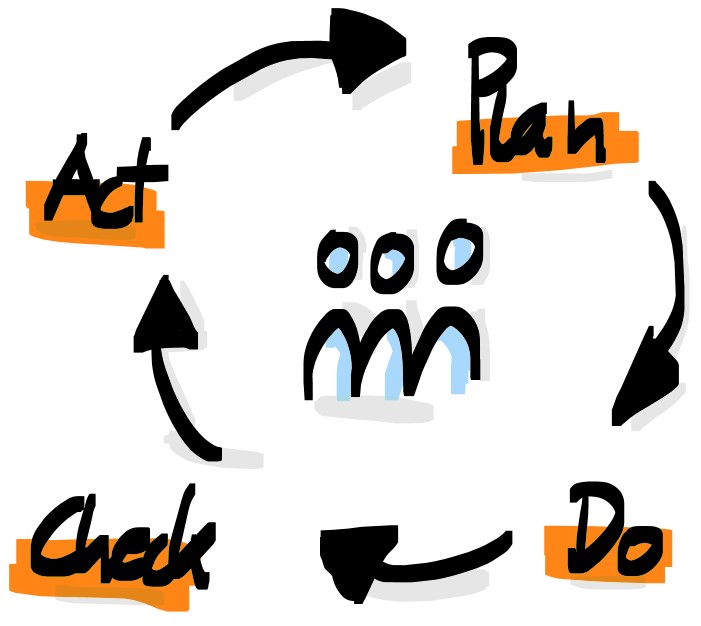
… Experimente zu machen (PDCA-Zirkel). Im agilen Wandel ist das erste Experiment oft, mit Command-and Control-Mitteln, also den misstrauensgeprägten Mitteln der Vergangenheit, den agilen Change zu bewerkstelligen.
Das kann gar nicht funktionieren. Denn: Agilität bedeutet ja Selbstorganisation, also: Vertrauen statt Misstrauen (Pull vs. Push). Das wissen die meisten Menschen aber VOR dem Change selten, sie ahnen es aber meist. Deshalb ist genau DAS erste Learning, die wichtige Erfahrung, aus der sie viel lernen.
Wer traut sich…
…an eine solch eine, manchmal sogar sehr unangenehme Lernerfahrung?
Naja, eben Menschen, die wissen und überzeugt sind, dass es sich lohnt. Dass es so wie bisher nicht mehr weitergehen kann in unseren Organisationen.
Sag ich doch.
Noch nicht überzeugt?
- Emiliani, Bob: The Triumph of Classical Management Over Lean Management. How Tradition Prevails and what to Do about it.
- Kotter, John P.: Accelerate. Building Strategic Agility for a Faster-Moving World.
- Laloux, Frederic: Reinventing Organizations
- Mazzucato, Mariana: Wie kommt der Wert in die Welt? Von Schöpfern und Abschöpfern
- Mezick, Daniel J.; Pontes, Deborah; Shinsato, Harold: The Open Space Agility Handbook
- Rigby, Darrell K.; Sutherland, Jeff; Takeuchi, Hirotaka: Embracing Agile. Harvard Business Review
- Roth, Gerhard: Über den Menschen.
- Schwaber, Ken; Sutherland, Jeff: Scrum Guide
- Senge, Peter M.: Die fünfte Disziplin. Kunst und Praxis der lernenden Organisation.
- Sutherland, Jeff: Die Scrum-Revolution. Management mit der bahnbrechenden Methode der erfolgreichsten Unternehmen.
- Sutherland, Jeff: Scrum. The Art of Doing Twice the Work in Half the Time
- Verheyen, Nina: Die Erfindung der Leistung
You want to work agile or more agile? You yourself are thinking about trying a little something in that direction? Now you have a couple of questions? You are not alone. I, for instance, have recently been asked:
What are the most important requirements for working Agile?
At least the smart people who are open to change always ask themselves if the preconditions for the change are in place. In the case of Agile, this question is particularly pressing to smart people (i.e., everyone) because they immediately notice ( naturally) that Agile means self-organization. And THAT IS SO DIFFERENT from the obsessive Command-And-Control culture we are currently working in! Therefor…
The most important prerequisite for agile working…
…is the realization that there is no other way than Agile anymore.
Who does not have this insight, will stick to the previous way of doing things. After all, we all usually only do things that seem (personally) meaningful to us.
In order to initiate more agile work in the team or the entire company, experience has shown that it is VERY important to give everyone VALUABLE opportunities to address the issue:
- What is Agile actually
- Why Agile at all
- Why does Agile proceed the way it just does, and most importantly:
- What does that mean for my own everyday work and what do I get out of it
Note on the side: To answer these questions different people need different amounts of time.
How management behaves…
…is one of the most decisive factors here. Why? If they do not exemplify agile working, i.e. if they behave as they always have, this sends a subtle but clear signal to everyone else: everything should stay the same. That’s just how we pack animals tick.
That’s why it the best thing to do…
… ist that first and BEFORE EVERYONE ELSE (!!!) the leadership circle is aware of Agile forms of collaboration, instead of just delegating or pushing the change. At the very least, it is done together and simultaneously with everyone else.
For managers should of course first understand why agile change is necessary and what it stands to gain. And also: what that means in the final analysis, namely:
- working at eye level,
- the hierarchy pyramid tilted,
- reduced co-dependencies and thus fewer opportunities for manipulation in secret,
- Dismantling of obstructive and costly power and status structures, etc.
And, yes: executives should be involved upfront even if that could blow off agile change before it gets started. Because that’s the ONLY CHANCE to minimize annoying guerrilla fighting from opponents of agile change at a later date. ( Battles will still happen, but just not as many and with not as many casualties).
Ideally…
…THAT would be the best way. However, this path is chosen less often than one would think. Meaning: Of course, the “ Agile marching orders“ are often first issued without being understood: „You go Agile, with us in management nothing changes. Oh, and by the way, if you don’t get Agile fast, you’re going to get kicked out soon.“
Of course, doing so is – well – less than ideal. In fact, it’s disastrous. However, underlying this is seldom bad intention, but rather the contrary. The command is precisely what has been the task and nature of (Tayloristic) management up to now. As a result, organizations and also managers within these organizations hardly know more than this means to get things moving.
First and foremost, Agile means…
… Running experiments (PDCA circles). In Agile change, the first experiment is often to use command-and-control manners, the mistrust-ridden methods of the past, to accomplish Agile change.
This cannot work at all. Because: Agile means self-organization, so: trust instead of mistrust (pull vs. push).But most people rarely know this BEFORE the change, though many suspect it. Therefore, exactly THAT is the first learning, the important experience, from which they learn a lot:… Running experiments (PDCA circles). In Agile change, the first experiment is often to use command-and-control manners, the mistrust-ridden methods of the past, to accomplish Agile change.
This cannot work at all. Because: Agile means self-organization, so: trust instead of mistrust (pull vs. push).But most people rarely know this BEFORE the change, though many suspect it. Therefore, exactly THAT is the first learning, the important experience, from which they learn a lot. Ordering is the opposite of Agile.
Who would dare to…
… take on this sometimes even very uncomfortable learning experience?
Well, people who know and are convinced that it is worth it.That things need to change in our organizations.
Told you.
Still not convinced?
- Emiliani, Bob: The Triumph of Classical Management Over Lean Management. How Tradition Prevails and what to Do about it.
- Kotter, John P.: Accelerate. Building Strategic Agility for a Faster-Moving World.
- Laloux, Frederic: Reinventing Organizations
- Mazzucato, Mariana: The Value of Everything: Making and Taking in the Global Economy
- Mezick, Daniel J.; Pontes, Deborah; Shinsato, Harold: The Open Space Agility Handbook
- Rigby, Darrell K.; Sutherland, Jeff; Takeuchi, Hirotaka: Embracing Agile. Harvard Business Review
- Schwaber, Ken; Sutherland, Jeff: Scrum Guide
- Sutherland, Jeff: Scrum. The Art of Doing Twice the Work in Half the Time