„It’s easier to do trivial things that are urgent than it is to do important things that are not urgent. Like thinking.“
John Cleese
Wir alle stehen heutzutage unter einem enormen Druck, innovativ zu sein, Ideen zu haben, die gut ankommen und große Geschäfte versprechen. Kreativität ist gefragt. Doch leider lernen wir nicht, wie das geht. Im Gegenteil!
Von klein auf und quer durch Schule, Berufsausbildung, Studium lernen wir zu tun, was uns von Lehrplänen vorgegeben und von LehrerInnen vorgebetet wird. (Wenn wir das gut tun, bekommen wir gute Zensuren.) So lernen wir die mutmaßlich notwendigen Handgriffe und mutmaßlich hilfreichen Denktrampelpfade. Die können wir dann auswendig.
Denn das war und ist am hiesigen Produktionsstandort gefragt. Hier haben vor allem die Prozesse stabil und effizient zu funktionieren.
Kreativität stand also noch nie hoch im Kurs. (Das letzte bisschen Ausbildung in dieser Hinsicht wurde in den letzten Jahren naturwissenschaftlichen Fächern geopfert. Beschäftigung mit Kreativität und Musisches ist seither Privatsache. Eine Katastrophe!)
Wie wir struktiert und gemeinsam Ideen entwickeln, sie auf Tauglichkeit und (wirtschaftliche) Tragfähigkeit prüfen und (!) funktionierende Geschäftsmodelle daraus machen, all das wurde und wird uns nicht beigebracht.
Das rächt sich heute.
Denn immer öfter fordern Kunden und Investoren profitable Innovationen. Also befehlen Manager in schöner anerzogender Command-and-Control-Tradition Kreativinitiativen und -meetings: „Gute! Ideen! Und zwar jetzt! Sonst läuft uns der Wettbewerber den Rang ab!“
Man ahnt, dass unter diesen Bedingungen eher weniger gute Ideen zustandekommen werden.
Was tun?
Lehre- und Ausbildung lassen uns einmal mehr im Regen stehen. Kümmern wir uns also wieder selbst drum.
Wer professionelle Kreativitätsroutinen sucht, dem könnte ein Vortrag von John Cleeses helfen: https://www.youtube.com/watch?v=Pb5oIIPO62g. Darin spricht er von zwei Modi:
- Einen geschlossenen Modus für konzentriertes Abarbeiten von Aufgaben.
- Und einen offenen Modus für das entspannte kreative Brainstorming und spielerische Entdecken von Möglichkeiten.
Wer versucht, im geschlossenen Modus kreativ zu sein, kann nur scheitern. Und andersherum.
Was ich mir aus dem Vortrag merke
- Kreativität ist viel mehr professionelles Handwerk als Talent
- Kreativität lässt sich also erlernen.
- Dazu braucht es Voraussetzungen. Die können (und müssen) organisiert werden.
Hier geht’s zum Video auf Youtube: https://www.youtube.com/watch?v=Pb5oIIPO62g
Was mir sonst noch so einfällt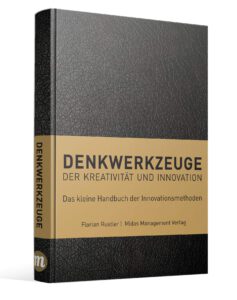
- Rustler, Florian: Denkwerkzeuge der Kreativität und Innovation. Das kleine Handbuch der Innovationsmethoden. St. Gallen u.a., 2016.
- Luther, Michael: Das große Handbuch der Kreativitätsmethoden. Wie Sie in vier Schritten mit Pfiff und Methode Ihre Problemlösungskompetenz entwickeln und zum Ideen-Profi werden. Bonn, 2013.
„It’s easier to do trivial things that are urgent than it is to do important things that are not urgent. Like thinking.“
John Cleese
These days, there is enormous pressure to be innovative, to have good (!) new (!) ideas that may be well received and promise big business. Creativity is now in demand. Unfortunately, we do not learn how to do that. On the contrary!
From childhood to professional education, we learn to do what we are told. (If we do that particularly well, we get good grades.) In this way, we learn the (presumably) necessary craft and (presumably) good ways of thinking. We know these „best practices“ by heart.
At production sites, creativity has never been popular. Understandably, everything there is supposed to work efficiently.
However, the one-sided focus on efficiency is a bit unfortunate today. (The last bit of musical and creative education has been sacrificed in recent years. In favor of the natural sciences. Since then it has been delegated to the private sphere.)
That’s why we were never taught how to develop ideas together in a structured way, how to test them for their viability and (economic) suitability, and how to develop business models from them.
This is taking its toll today.
Because customers and investors are increasingly demanding profitable innovations. So managers, in the tradition of command-and-control, order creative initiatives and meetings: „Ideas! Good ones! And we need them now! Otherwise, the competition will outrun us!“
So what to do?
It’s easy to sense that, under these conditions, good ideas are less likely to emerge.
Since curricula and training programs have once again failed us, we probably have little choice but to take care of it ourselves.
A lecture by John Cleese could serve as a very helpful introduction to all looking for professional creativity routines. Cleese talks about two modes:
-
- A closed mode for concentrated processing of tasks.
- And an open mode for relaxed creative brainstorming and playful discovery of possibilities.
If you try to be creative in closed mode, you can only fail. And the other way round.
My Take-Aways From The Lecture
- Creativity is more a professional craft rather than talent.
- Therefore, creativity can be learned.
- That requires preconditions. These can (and must) be organized.
What Else Comes to My Mind
- Rustler, Florian: Denkwerkzeuge der Kreativität und Innovation. Das kleine Handbuch der Innovationsmethoden. St. Gallen u.a., 2016.
- Luther, Michael: Das große Handbuch der Kreativitätsmethoden. Wie Sie in vier Schritten mit Pfiff und Methode Ihre Problemlösungskompetenz entwickeln und zum Ideen-Profi werden. Bonn, 2013.