Sie wollen oder sollen agil arbeiten? Sie beginnen mit Scrum zu arbeiten oder versuchen sich in Management Y? Zur Erinnerung: Sie führen nicht nur Methoden ein.
Agilität verspricht viel, und das zu Recht
- Ergebnisse werden schneller und besser erzielt, Kundenwünsche, deren Machbarkeit und Unternehmensziele werden auf sehr gute Weise zusammengebracht.
- Das Know-How der Mitarbeiter wird maximal genutzt, die Motivation steigt.
- Die Organisation wird wendig und schnell.
- Kunden, Mitarbeiter und Zulieferer werden zufriedener.
- Die Methoden und Instrumente sind nachvollziehbar, eingängig und lassen sich einfach einführen.
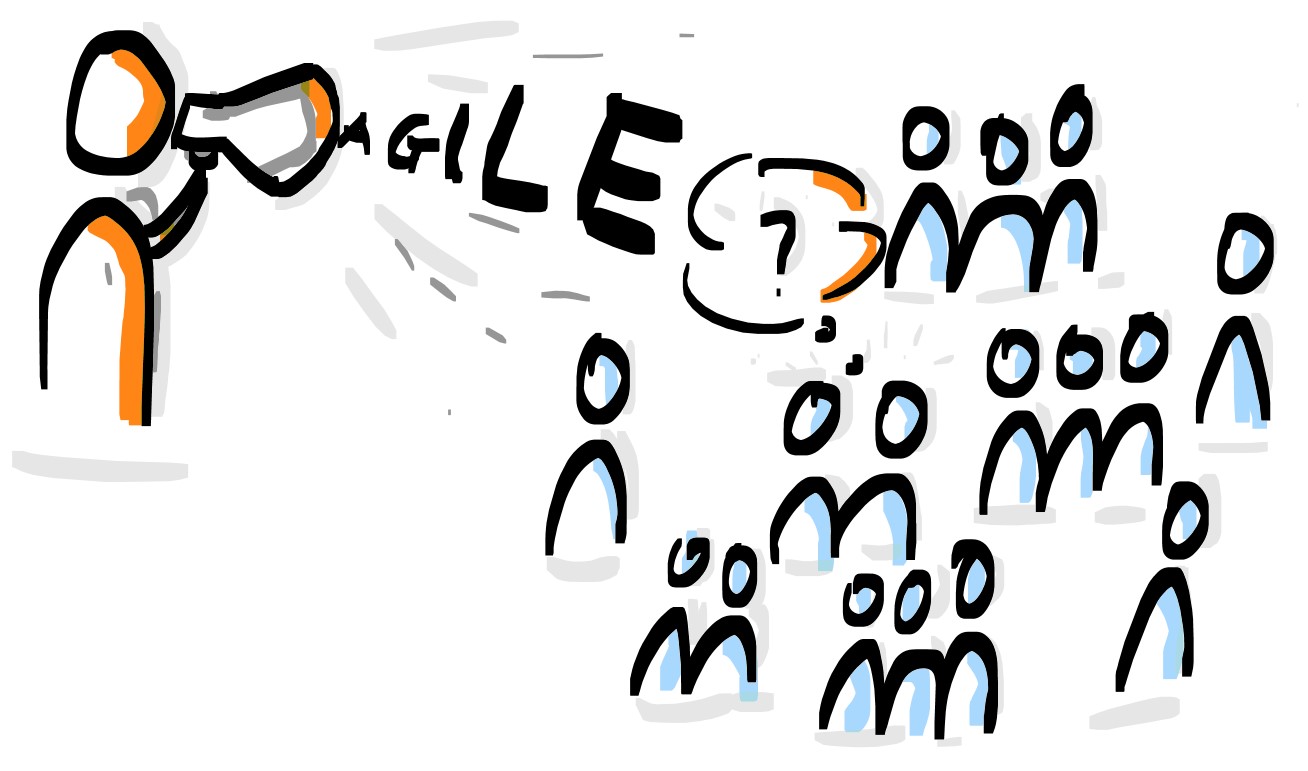
Die Vorteile liegen also auf der Hand. Warum ist der Schritt hin zu Agilität manchmal trotzdem so schwer?
Klingt gut! Das machen wir!
Verändern möchten sich Menschen und Organisationen oft dann, wenn sie unzufrieden sind: Wir sind weniger gut als wir sein wollen und können, wir sind zu unflexibel, zu langsam zu ineffizient.
Auf der Suche nach Lösungen geraten in solchen Situationen immer öfter agile Methoden in den Blick. Beim erwartungsfrohen Tunnelblick auf die Prozessverbesserung wird allerdings ein wichtiges Detail gerne übersehen:
Mit Agilität ist ein bestimmtes Verständnis von Organisation verknüpft, das für die Wirksamkeit und den Erfolg der Methoden ausschlaggebend ist.
Wer „A“ sagt…
Verantwortung
Jeder ist am Erfolg des Projekts oder der Unternehmung beteiligt und möchte dafür auch verantwortlich sein. Es ist notwendig, dass er Verantwortung übernehmen darf und es auch tut. Und zwar allgemein im Rahmen seiner Möglichkeiten, besonders aber im Rahmen seiner Rolle.
Motivation, Vertrauen & Kontrolle
Jeder ist von sich aus motiviert, sich mit allen seinen Mitteln für die gemeinsame Sache einzusetzen. Entsprechend werden Vertrauen groß und Kontrolle klein geschrieben.
Randnotiz: Kontrolle im Sinne von Überprüfung der Ergebnisse wird als eine wichtige organisatorische Aufgabe angesehen, wofür die Gruppe und nicht der Einzelne verantwortlich ist, z.B. ein/e ManagerIn.
Fehlerkultur
Es ist nicht möglich, genaue Vorhersagen zu machen, Unwägbarkeiten bestehen. Deshalb sind Fehler nicht zu vermeiden. Fehler sind positiv, denn nur so ist Lernen und Besserwerden möglich. Fehler werden von allen getragen, die ganze Organisation lernt daraus.
Denn das agile Weltbild erkennt an, dass dies ohnehin die Lebenswirklichkeit ist und insforn ohne Alternative.
Wertschöpfung & Erfolg
Nicht allein rechnerische Größen sind ausschlaggebend, auch qualitative Dinge sind sinnhaft und wertschöpfend (z.B. Kunden- und Mitarbeiterzufriedenheit und Lernerfolge).
Randnotiz: Damit nicht auch agile Organisationen Gefahr laufen, dies zu einem leeren Postulat verkümmern zu lassen, ist dies als strukturelles Element in die agile Struktur eingewoben, z.B. in den entsprechenden Rollenauffassungen oder der Feedback-Methodik.
Diese Beispiele machen deutlich, dass Agilität einen vergleichsweise starken Wertewandel vollzieht: Unternehmensziele und die Wege dorthin werden anders als bislang definiert.
So ist nur konsequent, dass viele der „herkömmlichen“ Strukturen und Managementmethoden im agilen Umfeld nicht nur weniger zu guten Ergebnissen beitragen, sie verhindern sie sogar.

Konkret bedeutet das z.B.
…häufig, dass trotz vereinbartem agilen Ablauf diplomatisch-politische Einmischungen stattfinden, Rollendefinitionen mittels taktisch-politischen Spielereien aufgeweicht oder außerhalb der zuständigen Gremien Prioritäten verschoben werden.
Wird dies dauerhaft zugelassen, sind sämtliche erhofften positiven Ergebnisse in Gefahr. Denn die Folge sind zwangsläufig massive Konflikte, die weit weg vom Ziel der reibungslosen und ergebnisorientierten Prozesse führen.
Wer Probleme erfolgreich (!) mithilfe der Agilität beheben möchte, kommt deshalb nicht umhin, die Veränderung auf zwei Ebenen zu vollziehen: Strukturen sind zu schaffen, indem die agilen Methoden benutzt werden.
Gleichzeitig gilt es, agile Werte zu integrieren, indem man sie lebt. Das gilt natürlich für jeden Change. Beim agilen Wandel aber vielleicht besonders.
…sagt manchmal nicht „B“
Natürlich ist möglich, agile Instrumente zu nutzen ohne die dahinterstehende Haltung zu übernehmen. Damit beschwört man unter Umständen aber Konflikte herauf, die nicht nur kurz- und mittelfristig die angestrebten reibungslosen und lösungsorientierten Prozesse verhindern, mit welchen man ja gerade Probleme beheben und bessere Ergebnisse erreichen möchte.
Diese Konflikte können auch zu einer riskanten Zerreissprobe für Teams, Abteilungen und ganze Organisationen werden und sie in gefährliche Schieflagen bringen.
Um dies zu vermeiden, erliegen Sie zunächst besser nicht den Verlockungen der agilen Methodik. Stattdessen fragen Sie sich ehrlich, ob agile Überzeugungen und Werte für Sie und andere in Ihrem Umfeld gelten oder in naher Zukunft gelten könnten.
 Um dies zu vermeiden, erliegen Sie zunächst besser nicht den Verlockungen der agilen Methodik. Stattdessen fragen Sie sich ehrlich, ob agile Überzeugungen und Werte für Sie und andere in Ihrem Umfeld gelten oder in naher Zukunft gelten könnten.
- Sind Sie, Ihre Chefs, Mitarbeiter, Kollegen, Kunden und Zulieferer (!) bereit, Kontrolle abzugeben, Vertrauen in den Einzelnen und in Gruppenentscheidungen zu haben, eine entsprechende Fehlerkultur zu etablieren, Privilegien und Status abzugeben etc.?
- Sind Sie wirklich bereit, nicht nur „A“, sondern auch „B“ zu sagen und eine agile Organisation zu werden?
Erst dann: Go for it! Denn dann wird es sich lohnen.
You want to work agile? You are expected to do so? You start working with Scrum or try your hand at Management Y? Remember: You are not just introducing methods.
Agility promises a lot, and rightly so
- Results are achieved faster and better, customer wishes, their practicability and company goals are brought together in a very good way
- The staff’s expertise is used to the maximum, motivation increases.
- The organisation becomes flexible and fast.
- Customers, employees and suppliers become more satisfied.
- The methods and instruments are comprehensible, catchy and easy to introduce.
So the advantages are obvious. Nonetheless, why is it sometimes so difficult to move towards Agile?
Sounds good! That’s what we do!
People and organisations often want to change when they are dissatisfied: We are less good than we want to be and can be, we are too inflexible, too slow too inefficient.
When looking for solutions, agile methods are increasingly coming under consideration. Yet in the expectant tunnel vision of process improvement, one important detail is often overlooked:
Agile is linked to a certain understanding of organisation, which is crucial for the effectiveness and success of the methods
He who says „A“…
Responsibility
Everyone has a stake in the success of the project or venture and wants to take responsibility for it. It is necessary that they are allowed to take on responsibility and do so. Generally within the scope of their possibilities, but especially within the scope of their roles.
Motivation, trust & control
Everyone is intrinsically motivated to devote all their resources to the common cause. Accordingly, trust is emphasised and control is treated as a lower priority.
Randnote: Control in the sense of checking the results is seen as an important organisational task, for which the group and not the individual is responsible, e.g. a manager.
Error culture
There is no way to make accurate predictions, uncertainties exist. Therefore, mistakes cannot be entirely avoided. Mistakes are positive, because that is the only way to learn and improve. Mistakes are carried by everyone, the whole organisation learns from them.
Because the Agile worldview recognises that this is the reality of life anyway and without alternative for the time being.
Value creation & success
Not only arithmetical values are decisive, also qualitative things are meaningful and value-adding (e.g. customer and employee satisfaction and learning success).
Side note: To ensure that agile organisations do not also run the risk of letting this wither away to an empty postulate, this is woven into the agile structure as a structural element, e.g. in the corresponding role perceptions or the feedback methodology.
These examples make obvious that Agile is undergoing a comparatively strong shift of values: Corporate goals and the ways to achieve them are being defined differently than before.
So it is only consistent that in the agile environment many of the „conventional“ structures and management methods not only contribute less to good results, they actually prevent them.
In concrete terms, this means, for example
… that despite an agreed Agile process, diplomatic-political interferences take place, role definitions are softened by means of tactical-political gimmicks or priorities are shifted outside the responsible bodies.
If this is allowed to continue, all hoped-for positive results are in danger. For the result is inevitably massive conflicts that lead far away from the goal of smooth and result-oriented processes.
Whoever wants to successfully (!) remedy problems with the help of Agile, can therefore no longer avoid making the change on two levels: Structures are to be created by using Agile methods.
At the same time, it is important to integrate Agile values by living them. This applies to every change, of course. But perhaps especially in the case of an agile change.
…sometimes doesn’t say „B“
Of course it is possible to use Agile tools without adopting the mindset that lies beneath them. However, this can lead to conflicts, which not only prevent the desired smooth and solution-oriented processes in the short and medium term, but also prevent problems from being solved and better results from being achieved.
These conflicts can also become a risky test for teams, departments and entire organisations and lead them into dangerous imbalances.
- Are you, your bosses, employees, colleagues, customers and suppliers (!) willing to relinquish control, have trust in individuals and group decisions, establish an appropriate culture of error, give up privileges and status, etc.?
- Are you really ready to say not only „A“ but also „B“ and become an Agile organisation?
Only then: Go for it! Because then it will be worth it.