Problem talking creates problems.
Solution talking creates solutions.
Wir müssen sprechen. Und zwar über die richtigen Dinge. Und auf eine gute Art und Weise. Zumindest sollten wir das dann tun, wenn wir uns und unser Geschäft erfolgreich neuen Gegebenheiten anpassen wollen oder müssen. Ein kleines Einmaleins von Veränderungsvorhaben.
Vielerorts ist Nervosität, Aufregung, ja, manchmal sogar blanke Angst zu spüren ob der viel zitierten disruptiven und verändernden Kräfte, die heutzutage auf so vielfältige Weise auf so viele Bereiche wirken und dabei so viele etablierte Geschäftsfelder umgestalten.
Es wird ungemütlicher. Und das, obwohl uns das doch so lästig ist. Störungen mögen wir Menschen als (vermeintlich sehr intelligente) Gewohnheitstiere gar nicht. Lieber sind uns gewohnte Routinen, eingespielte Abläufe und Denkweisen. Also versuchen wir, Störendes möglichst schnell zu beseitigen. Hartnäckigeres bekämpfen wir sogar. Oder wir ignorieren einfach Dinge, die uns das Leben schwer machen. Auf dass sie sich in Luft auflösen!
Erst wenn all dies nichts nutzt und wir keine andere Wahl mehr haben, beginnen wir damit, uns der veränderten Lage anzupassen. Selbst wenn das bedeutet, unsere gemütliche Komfortzone mit all jenen Mustern zu verlassen, die uns bislang erfolgreich gemacht haben.
Problem talking creates problems…
In genau dieser heiklen, emotional und kognitiv schwer zu handhabenden und zu reflektierenden Situation finden sich heute also immer mehr Menschen, Teams, Firmen, ja ganze Branchen und – wenn wir ehrlich sind – sogar Gesellschaften.
Nachdem die letzten Jahre viel Energie in Abwehrkämpfe gegen die Störer (und die Störung selbst) gesteckt wurde, scheinen immer mehr Menschen zu erkennen: Wir müssen uns ändern. Auch wenn uns das schwer fällt. Let’s deal with it!
Doch: Wie? Was ist zu tun? Wie verändert „man“ sich eigentlich? So ganz generell? Und organisatorisch? Was heißt das für uns? In unserer ganz eigenen Situation? Schließlich ist die doch außergewöhnlich und mit nichts zu vergleichen. Bei uns herrschen doch immer schon besondere Umstände, wir sind eben ganz eigen…
Nichts sei praktischer als eine gute Theorie, heißt es nicht ganz zu unrecht. Sehen wir uns deshalb an, was die Systemtheorie darüber zu sagen hat, wie Systeme entstehen und sich entwickeln. Auch Organisationen sind Systeme. Woraus bestehen sie? Was macht sie aus?
Die wichtigste Erkenntnis
Organisationen (bzw. Systeme) be- und entstehen nicht aus Menschen, wie man leicht annehmen könnte. Sondern aus Kommunikationen./1/ Die aber werden – natürlich – durch Menschen gestaltet. Was als überkandidelte theoretische Haarspalterei wirken mag, ist sehr konkret und lebensnah gemeint. Und auch leicht nachvollziehbar:
Alles, was wir gemeinsam angehen – alle beruflichen und privaten Vorhaben, alle Aufgaben, die wir gemeinschaftlich angehen, Firmen, Abteilungen, Projekte, unsere Geschäfts- und privaten Beziehungen, Partner- und Freundschaften, Vereine, Parteien bis hin zum Staat und zur Gesellschaft – all das entsteht durch jene ganz konkreten Dinge, Sachfragen und Themen, über die wir in Bezug auf sie denken, sprechen und schreiben: in persönlichen Gesprächen, am Telefon, in Meetings, in der Kantine, Kaffeeküche und auf Parties, auch in Selbstgesprächen, in E-Mails, Protokollen, Social Media, in Blogs, Zeitungen, Nachrichtensendungen, Talkshows etc.
Indem wir kommunizieren – und nur dadurch (!) -, hauchen wir unserer Welt Leben ein. Und so eben auch unserer Organisation. Und: Dadurch, wie und wann, auf welche spezifische Art und mit wem wir sprechen, schreiben oder sonstig kommunizieren (auch: wann und mit wem wir das nicht tun), gestalten wir sie auf unsere eigene Art und Weise. Wir geben unserer Organisation (und Welt) damit – und ausschließlich damit – die Form, die sie eben hat.
So what?
Was soll uns das nun in unserer Situation helfen, die von uns verlangt, dass wir uns verändern und anpassen? Die uns dazu zwingt, uns aus der Komfortzone zu begeben? Jene Komfortzone, die aus den wirtschaftlichen und gesellschaftlichen Institutionen, Unternehmens- und Organisationsformen besteht, die wir uns im Verlauf des 20. Jahrhunderts zusammenkommuniziert haben: stabil, hierarchisch, ultraklar strukturiert, leistungsorientiert, mit stark vorgebenen Strukturen und Rollenverteilungen, Zuständigkeiten, Produktions- und Vermarktungsroutinen, Karrierewege, machtorientiert bis hin zum Zwanghaften, ja fast schon Gewalttätigen?
Helfen kann uns die Erkenntnis, dass für eine erfolgreiche strukturelle Veränderung oder Anpassung (Neudeutsch: Change), im Grunde nur ein einziges Mittel zur Verfügung steht: Anders (und das heißt oft: überhaupt) miteinander zu sprechen; über andere Dinge mit anderen Menschen auf eine andere Art und Weise; andere, neue Themen und Worte zu wählen und sie auf anderen, neuen Kanälen und in anderen Formen zu übermitteln; andere Menschen in anderen Zirkeln, Kontexten und Foren zu treffen und mit ihnen auf eine neue Art und Weise zu kommunizieren, zu entscheiden und zu dokumentieren.
… solution talking creates solutions.
 Konkret kann das natürlich sehr vieles bedeuten:
- Das siebenseitige Protokoll, das in Wirklichkeit keiner liest, durch das Fotoprotokoll mit den Post-Its an der Wand ersetzen.
- Offene Runden, MeetUps ins Leben rufen, in welchen Menschen aus unterschiedlichen Bereichen kreativere Ansätze erarbeiten können, auf die sie in ihren Silos gar nicht kommen können.
- Mit den KollegInnen von der Nachbarabteilung über Lösungen anfangen zu sprechen, statt ewig und immer wieder die Frage zu erörtern, wer was verbockt hat (oder endlich einmal klären, wer was ständig verbockt).
- Einige der vielen Abstimmungsrunden sein lassen und in manchen Bereichen Entscheidungen anders und schneller treffen.
- Lösungs- statt problemorientierte Sprache einführen.
- Kommando- und Befehlssprache durch gewaltfreie Kommunikation ersetzen (oder umgekehrt).
- Als Führungskraft für sich selbst anerkennen und dann „öffentlich“ thematisieren, dass man das Fachliche nicht mehr bis ins Detail kennen kann.
- Alle – Vorgesetzte und Mitarbeitende – das Mikromanaagement sein lassen (sich also auf die Zunge beißen, wenn man gerade wieder dabei ist, dem/der jeweils anderen zu erklären was er/sie wie zu tun hat).
- Kreisförmige statt hierarchische Organigramme zeichnen…
Doch warum sollen wir das tun?
Weil wir wissen, dass wie wir unsere Welt bislang gestaltet haben, wie wir also bislang kommuniziert haben, heute nicht mehr so erfolgsversprechend ist wie früher.
Jetzt geht es darum, herauszufinden, was uns nun in unserer aktuellen, eben tendenziell unsicheren und veränderten Situation helfen könnte. Die Art anzupassen, wie wir miteinander sprechen, ist die einzige Weise, uns neue Denk- und Handlungsroutinen und damit strukturelle Organisationsformen zu verschaffen, die dann eben auf die veränderte Umwelt besser passen.
Anders ausgedrückt: Bewusst gestaltete Narrative – das, worüber und wie wir miteinander sprechen (und was wir davon glauben) und worüber und wie nicht – sind das einzige Mittel, um uns zu verändern und unsere organisatorischen Strukturen so zu gestalten, dass wir mit ihnen weiterhin erfolgreich und gut leben können. Je bewusster, zielgerichteter und reflektierter wir gemeinsam darüber entscheiden und auch je früher wir damit beginnen, desto besser wird es für uns, unser Vorhaben und auch unser Umfeld sein. Nur so kommen wir unserer Verantwortung nach und sorgen dafür, dass sich die Dinge in die richtige Richtung entwickeln.
Wenn unser Veränderungsvorhaben gut werden soll, sollten wir unsere Worte mit Bedacht wählen. In Zeiten, in welchen Worte wie „Handelskrieg“ etc. plötzlich wie selbstverständlich verwendet werden, scheint mir dieser Hinweis besonders wichtig.
Dieser Text erschien zuerst am 25. November 2019 auf www.teamworkblog.de.
Anmerkungen
- /1/ Und zwar, das ist gar nicht so unwichtig: Aus „anschlussfähigen“ Kommunikationen. Befehle und Anordnungen gehören meistens nicht in diese Kategorie.
 Literaturhinweise

- Ameln, Falko von: Konstruktivismus. Die Grundlagen systemischer Therapie, Beratung und Bildungsarbeit.
- Ameln, Falko; Heintel, Peter: Macht in Organisationen. Denkwerkzeuge für Führung, Beratung und Change Management.
- Bauer, Joachim: Das Prinzip Menschlichkeit. Warum wir von Natur aus kooperieren.
- Harari, Yuval Noaḥ: Eine kurze Geschichte der Menschheit.
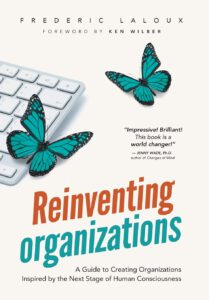
- Laloux, Frederic: Reinventing Organizations.
- Roth, Gerhard: Persönlichkeit, Entscheidung und Verhalten. Warum es so schwierig ist, sich und andere zu ändern.
- Simon, Fritz: Einführung in Systemtheorie und Konstruktivismus.
- Wilber, Ken: Wege zum Selbst.
Problem talking creates problems.
Solution talking creates solutions.
We need to talk. And we need to talk about the right things. In a good way. At least that’s what we should do if we want to successfully change. A few thoughts on a very important aspect of change projects.
Everywhere there is nervousness, unease, sometimes even sheer fear about the much talked about disruptive and transformative forces that are affecting so many industries in so many ways and reshaping so many established businesses in the process these days.
It is getting uncomfortable. And that’s even though it’s such a pain in the neck for us. As (supposedly very intelligent) creatures of habit, we humans don’t like disruption at all. We prefer familiar routines, well-rehearsed processes and ways of thinking. So we try to eliminate disturbances as quickly as possible. We even fight the more insistent ones. Alternatively, we simply ignore what makes life difficult for us. Let them vanish!
Only when all this is of no use and we have no other choice we start to change and adapt to the new situation. Even though this means leaving our cosy comfort zone with all those patterns that have made us successful so far.
Problem talking creates problems…
Today, more and more people, teams, companies, even entire industries and – frankly – even entire societies find themselves in precisely this delicate situation, which is difficult to handle and reflect upon emotionally and cognitively.
Having spent the last few years putting a lot of energy into defensive battles against the disruptors (and the disruption itself), more and more people seem to be realising: We have to change. Even if it’s hard for us to do so. Let’s deal with it!
But: How? What needs to be done? How does „one“ actually change? In general? And in terms of organisation? What does that mean for us? In our specific situation? After all, we can’t be compared to anything else. We have always had special circumstances, we are quite unique…
Nothing is more practical than a good theory, they say, and rightly so. So let’s take a look at what systems theory has to say about how systems emerge and develop. After all, organisations are systems too. So what do they consist of? How do they function?
The Most Important Finding
 Organisations (or systems) do not consist of and develop from people, as one might easily assume. They are made of communications./1/ However, these communications are – of course – made by people. What may seem like an excessively theoretical hair-splitting exercise is actually meant to be very concrete and true to life. And also easy to understand:
Everything we do together – all professional and private plans, all tasks we jointly carry out, companies, departments, projects, our business and private relationships, partner and friendships, associations, parties, all the way to state and society – all this originates from those very concrete things, issues and topics that we think, talk and write about in relation to them: In personal conversations, on the phone, in meetings, in the canteen, coffee kitchen and at parties, also in self-talk, in emails, minutes, social media, in blogs, newspapers, news programmes, talk shows, etc.
By communicating – and only by communicating (!) – we give life to our world. And thus also our organisation. And: By how and when, in which specific way and with whom we speak, write or communicate in any other way (also: when and with whom we do not do so), we shape it according to our preferences. In this way – and only in this way – we shape our organisation (and the world) the way it looks.
So what?
What is this insight supposed to help us in our situation, which demands that we change and adapt? That forces us to leave the comfort zone that consists of the economic and social institutions, corporate and organisational patterns that we have communicatively created in the course of the 20th century: Stable, hierarchical, ultra-clearly structured, performance-oriented, with strongly predefined structures and role definitions, responsibilities, production and marketing routines, career paths, power-oriented to the point of being coercive, even almost violent?
Well, it might be helpful to realise that for successful structural change or adaptation, there is literally one and only one means available: To communicate differently with each other (and that often means: to communicate at all); to talk about different things with other people in a different way; to choose different, new topics and words and to communicate them in different, new channels and forms; to meet other people in different circles, contexts and forums and to communicate, decide and document with them in a new way.
… solution talking creates solutions.
In concrete terms, of course, this could lead to many things:
- Replacing the seven-page protocol, which in reality no one has ever read, with the photo protocol with Post-Its on the wall.
- Setting up open forums, MeetUps, in which colleagues from different areas can work out more creative approaches that they can’t come up with in their silos.
- Start talking about solutions with colleagues from the neighbouring department instead of forever and again discussing who screwed something up (or finally clarifying who keeps screwing up what).
- Drop some of the many coordination committees and take decisions differently and more quickly in certain issues.
- Introduce language that focuses on solutions instead of problems.
- Replace command and order language with non-violent communication (or vice versa).
- As a manager, accept that it is no longer possible to know all the details of the technical issues. Discuss this „publicly“.
- Everyone – managers and team members – stop micromanaging (i.e. bite your tongue when you are in the process of explaining to the other person what he/she has to do and how).
- Draw circular instead of hierarchical organisational charts
- …
Yet, Why Should We Do This?
Because we know that what we have done so far, how we have shaped our world so far, how we have COMMUNICATED so far, is no longer good enough today. We are set to fail if we don’t adapt to the new circumstances.
Now it is a question of finding out what could help us in our current situation, which tends to be unstable and changing. Adjusting the way we talk to each other is the only way to create new routines of thought and action and thus structural organisational forms that are better suited to the changed environment.
In other words, consciously formed narratives – what we talk about and how we talk to each other (and what we decide to believe about it) and what and how we do not talk about it – is the only way to change and shape our organisations so that we can continue to be successful and do well with them. The more deliberately, purposefully and reflectively we decide on this together, and also the earlier we start, the better it will be for us, our projects and also our environment. Only in this way will we meet our responsibility and ensure that things develop in the right direction.
We want our change project to be good. So we should choose our words carefully. In times when words like „trade war“ etc. are suddenly being used naturally, this advice seems particularly important to me.
This article was first published on www.teamworkblog.de on 25 November 2019.
Remarks
- /1/ And this is important: From „connectable“ communications. Commands and orders do not usually belong in this category.
Literature
- Appelo, Jurgen: How to change the world.
- Harari, Yuval Noaḥ: Homo Deus. A Brief History of Tomorrow
- Laloux, Frederic: Reinventing Organizations. A Guide to Creating Organizations.