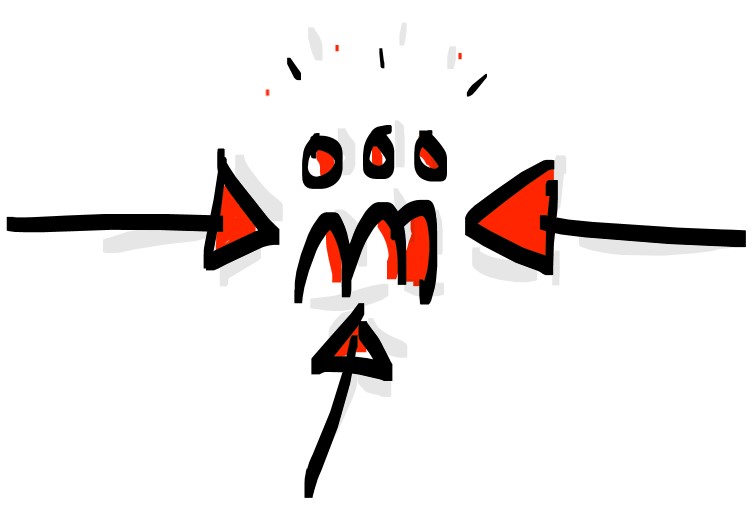
Krankheiten sind zurecht unsere private Angelegenheit
was eine Errungenschaft unserer modernen Welt ist. Doch ausgerechnet diese gute gesellschaftliche Übereinkunft verstellt uns in Leistungsfragen und den damit zusammenhängenden Schwierigkeiten den Blick auf wichtige Abhängigkeiten und Verantwortlichkeiten.
Gerade beim Thema Leistung, Stress und Burnout führt dies dazu, dass wir weit unter unseren Möglichkeiten bleiben und manche Situationen bedrohlich eskalieren.
Selbst schuld! Selbst schuld?
So gehen wir im allgemeinen davon aus, dass Stress und seine Folgen allein Sache der „Gestressten“ ist. Es ist ihre Sache, damit „klarzukommen“. Sie sind dem Druck einfach „nicht mehr gewachsen“. Sie sind eben die „Falschen auf dem Posten“. Ihnen ist halt „alles ein bisschen viel“, mit den Kindern, den pflegebedürftigen Eltern und den Projekten…
Tatsächlich ist aus der Stressforschung bekannt, dass die individuellen Umstände, die körperliche und psychische Ausstattung sowie die persönlichen Bewältigungsmuster eine entscheidende Rolle bei der Stressbewältigung spielen („interne“ Vorgänge).
Mindestens ebenso wichtig aber – und in organisatorischer Perspektive vielleicht noch wichtiger – sind die Strukturen und Impulse des beruflichen und privaten Umfelds („externe“ Vorgänge).
Was bedeutet das für unser Leistungsstreben und unseren Umgang mit Druck bzw. Stress?
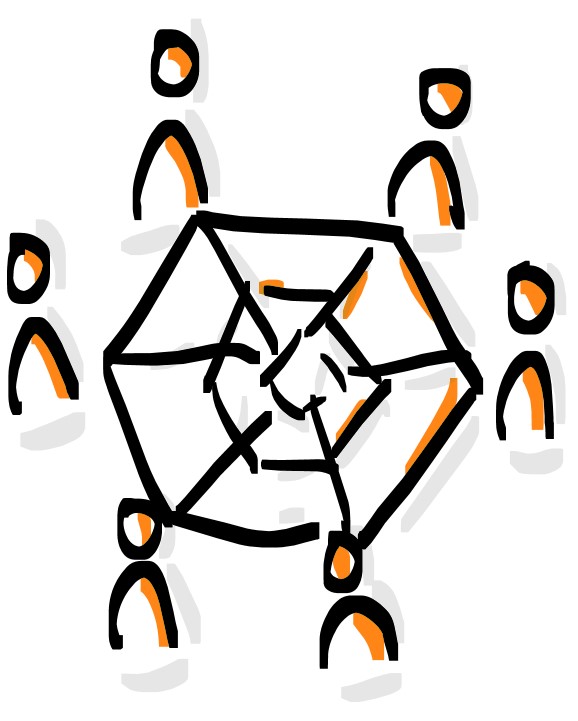
Alle Mitglieder einer Organisation
also Inhaber, Vorgesetzte, MitarbeiterInnen, Teammitglieder, Zulieferer und Kunden usw. – befinden sich in wechselseitigen und abhängigen Beziehungen. Sie ergeben ein Geflecht komplexer dynamischer Systeme, die sich gegenseitig beeinflussen.
Im „gesunden“ Zustand führt diese Dynamik zu hoher Leistung und zur zufriedenstellenden Wertschöpfung. Erkranken aber Teile der Organisation, erkrankt mit ihm die Organisation.
Sie ist insgesamt geschwächt und in der Leistung eingeschränkt. Die „kranken“ Menschen zeigen dies lediglich als „Symptomträger“ an.
Stress ist gut! Ist Stress gut?
Stress ist ein sehr altes, archaisches Muster. Es wirkt bei einzelnen Menschen genauso wie in Gemeinschaften, wozu auch Organisationen zählen.
Der evolutionäre Sinn von Stress ist, schwierige Situationen mit punktuell starkem Fokus und maximalen Kräften bewältigen zu können. Kurze Stressphasen führen deshalb mitunter zu ungeahnten Leistungssprüngen.
Stress ist also gut. Allerdings nicht immer.
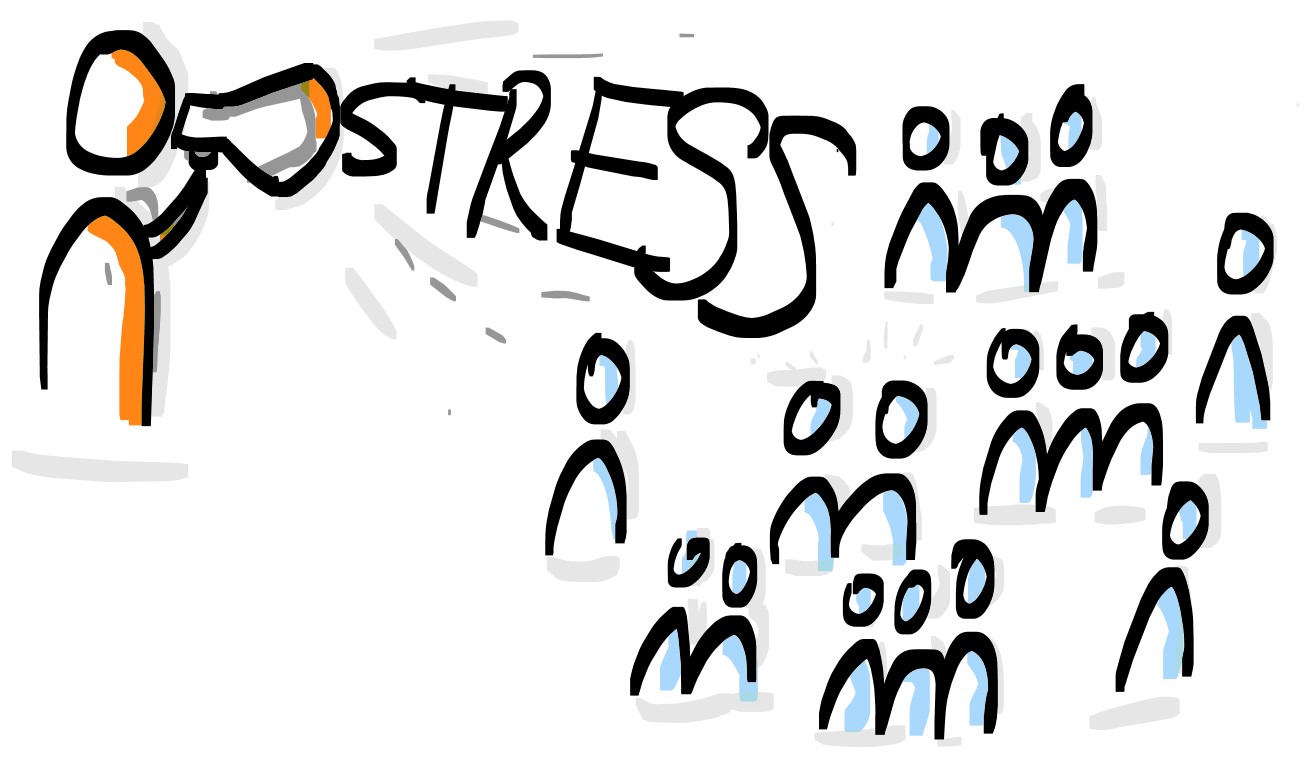
Wenn Menschen und Organisationen über längere Zeit Stressdynamiken ausgesetzt sind
wirkt Stress auf vielen psychischen und physischen Ebenen ungut: Der konzentrierte Tunnelblick schränkt den Horizont und die Kreativität ein, mentale wie körperliche Kräfte werden über Maßen an falschen Stellen verausgabt ohne sich wiederaufbauen zu können usw.
Die Folge ist ein zunächst schleichender, im weiteren Verlauf immer schneller werdender Leistungsabfall:
- Situationen werden verzerrt wahrgenommen,
- Entscheidungen werden schlechter getroffen,
- das Einfühlungsvermögen sinkt,
- der Aggressionspegel steigt,
- Konflikte häufen sich,
- Zeit und Energie verpuffen unproduktiv,
- die Fähigkeit zur Erholung geht verloren.

Die Folge ist oft der Ausfall Einzelner.
Die dadurch entstehenden Leistungslücken werden vom Team aufgefangen, was die allgemeine Stressspirale im Unternehmen noch mehr antreibt. Es kommt zu vermehrten Ausfällen usw. Im schlimmsten Falle droht so der Burnout des gesamten Teams.
Dies erklärt, warum Stress und Stresserkrankungen „ansteckend“ sind. Beides kann schnell um sich greifen, und oft genug geschieht dies auch.
Für alle Beteiligten ist das unangenehm./1/ Und für Unternehmen ist es: sehr teuer.
Das hängt mit den akut auftretenden Ausfallkosten zusammen.
Vor allem aber bleiben Firmen auf längere Sicht weit unter ihrem eigentlichen Leistungsniveau. Viele Firmen, Führungskräfte, Personaler und auch KollegInnen spüren das intuitiv.
Also werden sie schnell aktiv, z.B. indem sie stressanfälligen oder stresserkrankten MitarbeiterInnen entweder andere Aufgaben übertragen oder ihnen ermöglichen, die Posten oder Abteilungen zu wechseln. Meist weiß man sich auch schlicht nicht anders zu helfen, als die „erkrankten“ Menschen „im gegenseitigen Einvernehmen“ zu isolieren und dann zu ersetzen.
Lokale Maßnahmen dieser Art scheinen naheliegend, sie verzögern aber echte Lösungen für das veritable Leistungsproblem, weil man die wahren Ursachen nicht angeht. Gleichzeitig verschärfen sie es – zum noch größeren Leidwesen der gesamten Belegschaft, ihrer Motivation und vor allem: des Profits.
 Stressbewältigung als organisatorische Aufgabe
 Stressbewältigung als organisatorische Aufgabe
Hilfreicher ist deshalb, Stresssymptome auch organisatorisch als das zu betrachten, was sie sind: Mittel- bis langfristig leistungsmindernde Situationen, die durch das ungünstige Zusammentreffen unterschiedlicher Umstände und vor allem gestörte Wechselbeziehungen innerhalb des Systems verursacht werden.
Stress und seine Folgen resultieren nie auf nur einer einzelnen Ursache, also z.B. allein dem/der Erkrankten, einem Verhalten einer bestimmten Führungskraft oder einem spezifischen Teamprozess.
Soll also die gesamte Organisation möglichst schnell wieder maximal leistungsfähig werden, eine weitere Ausbreitung unguter Entwicklungen verhindert („Musterwiederholung“) und zukünftig eine „Wiederansteckung“ verhindert werden, sind alle (!) Ursachen für den „Infekt“ zu suchen und anzugehen. Und zwar an verschiedenen Stellen im gesamten System.
Tabus brechen – gemeinsam und wertschätzend
Dazu ist zunächst eine gute Analyse der Situation nötig. Gut bedeutet, alle Beteiligte möglichst wertschätzend und wohlwollend miteinzubeziehen und ehrlich miteinander umzugehen.
Erfahrungsgemäß sind Leistungs- und Stressthemen und insbesondere Burnout allgemein angstbesetzt, tabuisiert und hochemotional (also bei Betroffenen, Geschäftsführungen, Führungskräften, Personalabteilungen, Teammitgliedern, Betriebsräten etc.). Deshalb sind die Menschen einer Organisation selten in der Lage, eigenständig den Lösungsprozess erfolgreich anzugehen und anzuleiten.
Eine kompetente externe Begleitung ist dafür also sehr ratsam.
Und so könnte die gemeinsame Route aussehen:
1. Anfangs ist besonders wichtig zu klären, ob betroffene Mitarbeiter „nur“ auf dem Weg sind auszubrennen oder ob sie bereits erkrankt sind (z.B. an einer Erschöpfungsdepression). Dies macht ein (Fach-) Arzt.
2. Gleichzeitig ist die Situation im erweiterten beruflichen Umfeld des Erkrankten gründlich zu analysieren: Wie ist die Arbeitssituation? Welche Konflikte bestehen wo, mit wem und weshalb? Gibt es individuelle oder allgemeine Überlastungssituationen und wie sind sie gestaltet? Etc. /2/
3. Nach der Analyse wird idealerweise im Einvernehmen mit den direkt Betroffenen darüber entschieden, was auf der individuellen und der organisatorischen Ebene geschieht:
- Für den Einzelnen bedeutet das in akuten Fällen oft, dass er zunächst die Möglichkeit und die nötige Zeit erhält, aus einer angespannten Stresssituation herauszukommen und gesund zu werden.
- Erst danach macht Sinn, sich weiteren Fragen zur konkreten Arbeitssituation zuzuwenden, ggf. Ändern von Teamstrukturen, -zielen und -umgangsformen, der Umgestaltung des Arbeitsplatzes, die Verbesserung eigener Selbstmanagement-Kompetenzen oder gar ein Wechsel der generellen beruflichen Perspektiven.
4. Gleichzeitig und am besten sofort /3/ sind auf organisatorischer Ebene die Strukturen so zu verändern, dass sie für das gesamte Team wieder eine stabile Basis für (Höchst-) Leistungen abgeben. Dazu gehören prophylaktische und präventive Maßnahmen für das gesamte Team inklusive Führungsmannschaft, ggf. Personaler und Geschäftsführung: Aufklärung über (organisatorischen) Stress, seine Auswirkungen und einen guten zielgerichteten, leistungsorientierten Umgang mit ihm.
Es liegt nahe, dass diese Maßnahmen einen nachhaltigen Effekt nur haben
 Es liegt nahe, dass diese Maßnahmen einen nachhaltigen Effekt nur haben
und zu einer echten Verbesserung beitragen, wenn sie für alle Beteiligten authentisch und annehmbar sind.
Die Suche nach den geeigneten Maßnahmen kann ein langer und auch konfliktreicher Prozess sein. Der zahlt sich dadurch aus, dass Organisationen danach gestärkt, leistungsfähiger und zufriedener daraus hervorgehen.
Sind Sie, Ihr Team, Ihre Abteilung oder gar Ihre Firma also gestresst?
Dann gehen Sie das Problem sofort an! Beginnen Sie damit, wieder gesund und leistungsfähig zu werden!
Das wird Ihre Zufriedenheit, Ihren Arbeitsplatz und Ihren Profit auf lange Sicht sichern.

Literatur
- Bauer, Joachim: Arbeit. Warum unser Glück von ihr abhängt und wie sie uns krank macht. München, 2013
- Leibovici-Mühlberger, Martina: Die Burnout Lüge: Was uns wirklich schwächt und wie wir stark bleiben. edition a, 2013.
- Literaturliste zum Thema Burnout auf der Website der Münchner Burnout-Selbsthilfegruppe „Yourway 2 Life“.
- Rodehack, Edgar: „Vor einem Burnout? Mittendrin? Was tun?“ Blogpost vom 4. Mai 2015
- Ruhwandl, Dagmar: Top im Job – ohne Burnout durchs Arbeitsleben. Stuttgart, 2010.
- Scherrmann, Ulrich: Stress und Burnout in Organisationen. Berlin u.a., 2015.
- Striemer, Rüdiger: Raus! Mein Weg von der Chefetage in die Psychiatrie und zurück. Berlin, 2015.
- Unger, Hans-Peter; Kleinschmidt, Carola: »Das hält keiner bis zur Rente durch!« Damit Arbeit nicht krank macht: Erkenntnisse aus der Stress-Medizin. München, 2014.
Anmerkungen
- /1/ Und manchmal lebensgefährlich.
- /2/ Das private Umfeld ist ebenso wichtig, aber eben Privatsache. Und insofern einer privaten Therapie und der Entscheidung des Einzelnen vorbehalten.
- /3/ Denn auch andere Teammitglieder können sich inzwischen an den allgemeinen Umständen aufgerieben haben und in einem Stresstunnel sein.
Are you stressed? Do your colleagues complain about too much stress? Are team members already absent? Maybe explicitly because of burnout? Then you should deal with it immediately. Because burnout is not only very dangerous to health. It is also very expensive. And contagious.
Illness is our private affair.
Which is a great achievement of our modern world. Sadly, it is this good social agreement that prevents us from seeing important dependencies and responsibilities in terms of performance and the challenges associated with them.
As a result, we remain far below our capabilities when it comes to performance, stress and burnout. And some situations escalate in a very dangerous,. sometimes even life threatening way.
Your Fault! Your Fault?
In general, we assume that stress and its unpleasant consequences are the sole responsibility of the „stressed persons“. They have to „deal with it“. After all, they simply cannot withstand the pressure anymore. They are just the „wrong people on the job“. It’s just „too much“ for them, with the children, the parents in need of care and – of course – the projects at work…
Individual circumstances, the physical and psychological equipment as well as personal coping patterns play a decisive role in dealing with stress („internal“ processes). We have known this from stress research for a long time.
Equally important – and from an organizational perspective perhaps even more important – are the structures and impulses of the work and private environment („external“ processes).
So what effect does this have on our striving for performance and success and on how we deal with pressure and stress?
All members of an organization
owners, managers, employees, team members, suppliers and customers, etc.- are mutually dependent on each other. They form a network of complex dynamic systems that influence each other.
In a „healthy“ state, these dynamics lead to high performance and satisfactory added value. However, if parts of the organization fall ill, the whole organization falls ill.
It is weakened as a whole and its efficiency is limited. The „sick“ people merely indicate this as „symptom carriers“.
Stress Is Helpful! Is stress really helpful?
Stress is a very old evolutionary and archaic pattern. This pattern works for individuals as well as for communities (and thus for organizations).
Stress helps us to cope with difficult situations: We have a strong focus and use all our strengths and abilities. That’s the reason, why short periods of stress often lead to overwhelming leaps in performance.
So: Stress is helpful and good. But only under certain circumstances.
If people and organizations are exposed to stress over a longer period of time
this has a negative effect on many psychological, physical and social levels: tunnel vision limits our flexibility and creativity, we waste mental and physical energy and this mostly in the wrong places and without being able to regenerate, etc.
As a consequence, our overall performance decreases. Big time. At first, we hardly notice it because it happens very slowly. In the further course of time, however, it happens faster and faster.
- Our perception suffers.
- We assess situations distorted and simply wrong.
- We lose empathy towards ourselves and others.
- We get more aggressive.
- We find ourselves in more and more fights (over silly things).
- We switch to automatic and survival mode.
- We become inflexible and our decisions get worse and worse.
- We waste time and work unproductively.
- Mentally and physically we wear out, we can’t recover anymore. And so on.
As a result, people drop out
Causing performance gaps. These gaps have to be compensated by the team, which drives the stress spiral even more. This again leads to increased sick leave etc. The worst case is looming: Burnout of the whole team.
This is the reason why stress and stress disorders are „contagious“. Both can quickly spread. And often enough exactly this happens.
It is unpleasant for everyone involved, to say the least./1/
And for companies, it is first and foremost: very, very expensive.
Naturally, this is due to the acute costs caused by team members on sick leave.
More importantly, though: Companies stay far below their performance level they actually could achieve – and this is for a very long time. Many companies, managers, personnel and colleagues intuitively know this.
So they react quickly, e.g. by either giving stress-prone or stress-ill employees other tasks or by allowing them to change jobs or departments. Often and regrettably (and brutally), they help themselves by simply isolating and replacing the „sick“ people „by mutual agreement“.
Local measures of this kind seem obvious and normal in our world (regrettably). In reality, however, they delay or even prevent real solutions to the huge performance problem. That’s because – clearly – the root causes are not addressed. And it gets even worse: At the same time, those measures intensify the problem – to the even greater suffering of the entire workforce, their motivation and: the profit.
Stress Management – a Job for Everyone
A more helpful and effective way is to simply recognize stress symptoms for what they are: Warning signals that performance and company success is at risk in the short, medium and long term. Warning signs that there are disrupted, obstructive interrelationships within the organization, caused by various unfortunate circumstances and ill-considered, unwise actions (doing the wrong things at the wrong time by the wrong people in the wrong place).
Stress and its consequences never result from just one single cause, e.g. the stressed person alone, certain behavior of a certain manager or a specific team process.
So if you want to make sure that the entire organization gets healthy and is performing at a high level again as quickly as possible, if you want to stop poor and counteracting habits („pattern repetition“), if you want to prevent a „re-infection“ in the future, you will have to look for all (!) causes of the stress „infection“ at various places throughout the organization. And then tackle them. One by one.
Breaking Taboos – Together and Appreciative
To do this, you must first analyze the situation thoroughly and in a good way. Good means involving everyone affected as much as possible in a respectful and well-meaning manner. Good also means being as honest as possible with each other.
Performance and stress issues and especially burnout are unpleasant for most people, they are taboo and usually, they are (without us realizing it) treated highly emotionally. This applies equally to those directly involved, but also to management, executives, HR departments, team members, work councils, etc. This is the reason why people in an organization can rarely approach and guide the solution process successfully on their own: There are too many (emotional) blind spots.
Therefore, the only chance to succeed the way is: hiring competent external support.
This could be a joint route:
1. In the beginning, it is particularly important to clarify whether affected employees are „only“ on their way to burnout or whether they are already ill (e.g. suffering from depression). This is done by a (specialist) doctor.
2. At the same time, the patient’s extended professional environment must be thoroughly investigated and analyzed: What is the work situation like? What conflicts exist? Where, with whom and why? How long? Are there individual or general overload situations? Where do they (really) come from? How are they structured? Etc. /2/
3. After this joint (!) analysis, a decision is made about what is going to happen at the individual and organizational levels. Ideally, this is done together and in agreement with those directly affected.
4. For the sick person, this often means that he or she gets the opportunity and the time needed to get out of the tense stress situation and to fully recover.
5. This is particularly important because only after a full recovery it makes sense to jointly decide over further questions about the concrete work situation. It may be necessary to change team structures, adjust goals, talk about etiquette, reorganize the workplace, improve one’s self-management skills or even generally look at other career prospects.
6. At the same time, and preferably immediately/3/ change the structures at the organizational level so that they can be again a solid basis for good performance of the whole team. This includes precautionary and preventive measures (e.g. training sessions) for the entire team including (!) all (!) team managers. All of them must know about (individual and organizational) stress, its effects and good goal- and performance-oriented handling of it.
It is obvious that all of this can only have a sustainable effect
 It is obvious that all of this can only have a sustainable effect
and can only lead to improvement if they are authentic and acceptable for all people involved.
The search for the appropriate measures can take long and will surely be conflictual. However, all the effort pays off because people tend to be happier, more motivated, even stronger than before: The organization has learned a lot about how to deal with success and the strive for it together.
So are you, your team, your department or even your entire company stressed?
Do yourself and your co-workers a big favor: Address the problem immediately!
At this stage, it might not feel like it for you, but it already is a real, existential threat for all of you. Your colleagues, your clients and your entire business. Soon it will become an even bigger one.
Secure your health, your satisfaction, your job and your profit in the long run.
Get well again! Start with it today.
Notes
- /1/ And sometimes life-threatening.
- /2/ The private environment is just as
important, but it is a private matter. Insofar it is reserved for private therapy and the decision of the individual. - /3/ Because other team members can also have worn themselves out by the general circumstances and be in a stress tunnel.